This article has been reviewed according to Science X's editorial process and policies. Editors have highlighted the following attributes while ensuring the content's credibility:
Inside every electronic device, the flow of electricity is controlled by a switch called a transistor. For decades, these switches were made from silicon. More recently, engineers have turned to a material called gallium nitride (GaN), which enables small, efficient devices like smartphone chargers.
However, at very high voltages, electric fields inside these transistors can concentrate at specific points, causing them to fail prematurely. As a result, today's GaN devices still struggle to perform at the highest voltage levels achieved by silicon.
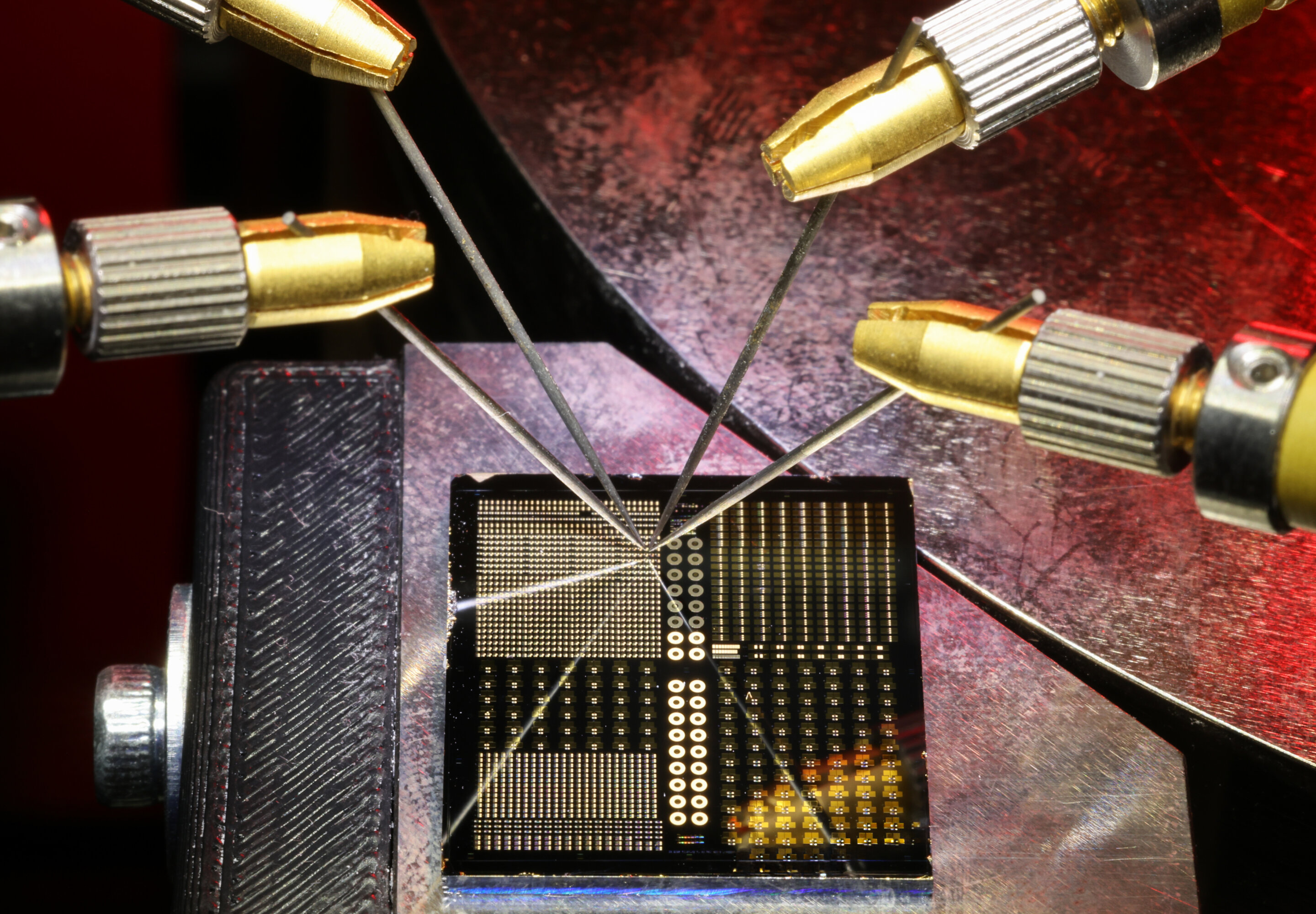
To overcome this limitation, researchers in the Power and Wide-band-gap Electronics Research Lab (POWERlab) in EPFL's School of Engineering have introduced a new class of GaN transistor: the intrinsic polarization superjunction, or iPSJ.
The chip-sized device, made from layers of gallium nitride on a low-cost silicon base, can withstand nearly 4 kilovolts (kV) before breaking down, a record for this type of technology. At the same time, it maintains low resistance, helping to reduce energy losses that would otherwise be released as heat.
The combination of high-voltage capability and low resistance is essential for efficient power conversion in AI data centers and renewable energy systems. "We achieve this by exploiting a natural polarization effect that is unique to GaN," explains POWERlab head Elison Matioli. "Our work could enable robust, efficient, high-voltage power electronics at much more compact scales."
Thanks to gallium nitride's crystal structure, internal electric forces gather mobile electrons into thin sheets that carry current.
Source link