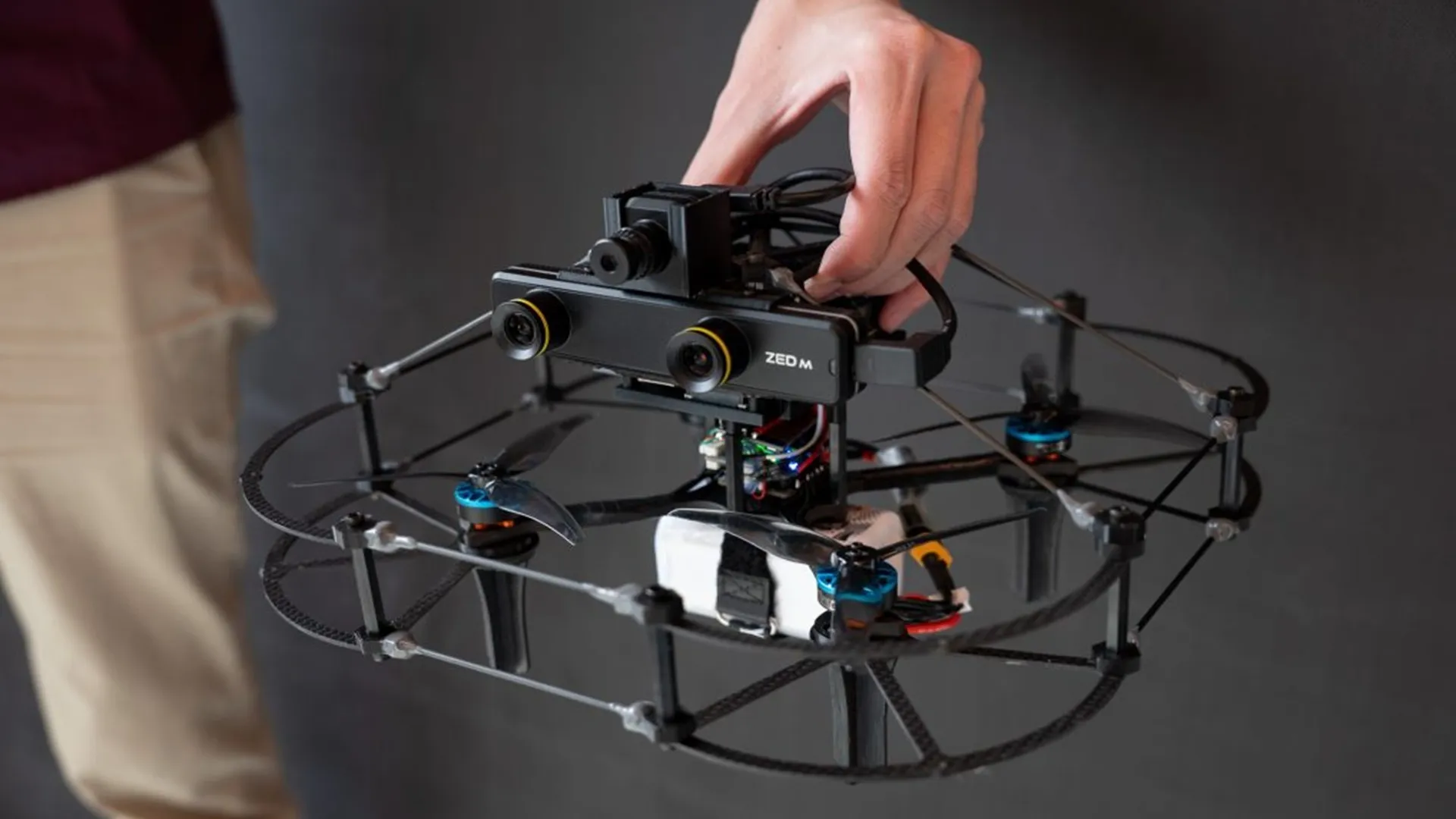
US researchers have developed an artificial intelligence tool that can process robotic vision data at up to 440 times per second, potentially allowing drones, autonomous vehicles, and other robots to respond faster to their surroundings.
Developed by engineers at the University of Pennsylvania, the system, called Fast Feature Field (F³), processes information from event cameras, which detect changes in light rather than capturing conventional images.
In tests, algorithms using F³ operated roughly two to five times faster than previous approaches. The system processed high-definition event-camera data 120 times per second and reached 440 times per second at lower VGA resolution.
The researchers say the technology could help robots recognize objects, estimate distances, and track movement more efficiently, particularly in challenging lighting conditions.
Unlike conventional cameras that capture complete images at fixed intervals, event cameras continuously detect changes in light intensity at individual pixels.
This allows them to capture rapid movements without recording entire frames. However, interpreting their output remains difficult because the cameras generate millions of individual signals rather than recognizable images.
Existing approaches typically require specialized algorithms for different tasks, limiting their wider use in robotics.
The Penn researchers addressed this problem by developing a neural network that learns to identify useful patterns in event-camera data.
Instead of programming the system separately for object recognition, motion tracking, or distance estimation, the team trained F³ to predict future events based on previous signals.
“To accurately anticipate future events based on past ones, the network must learn to represent both the structure of a scene and the motion taking place within it,” said Richeek Das, the paper’s first author.
Source link