This article has been reviewed according to Science X's editorial process and policies. Editors have highlighted the following attributes while ensuring the content's credibility:
Wearable sensors, such as wristbands, rings and adhesive patches, are becoming increasingly common for health care monitoring, fitness tracking and human-machine interaction. While most wearable devices are made from flexible polymers or textiles, paper-based sensors are emerging as cheaper and more sustainable alternatives. Such sensors could be used for applications such as medical diagnosis or detecting contaminants and toxins and could be safely discarded after use.
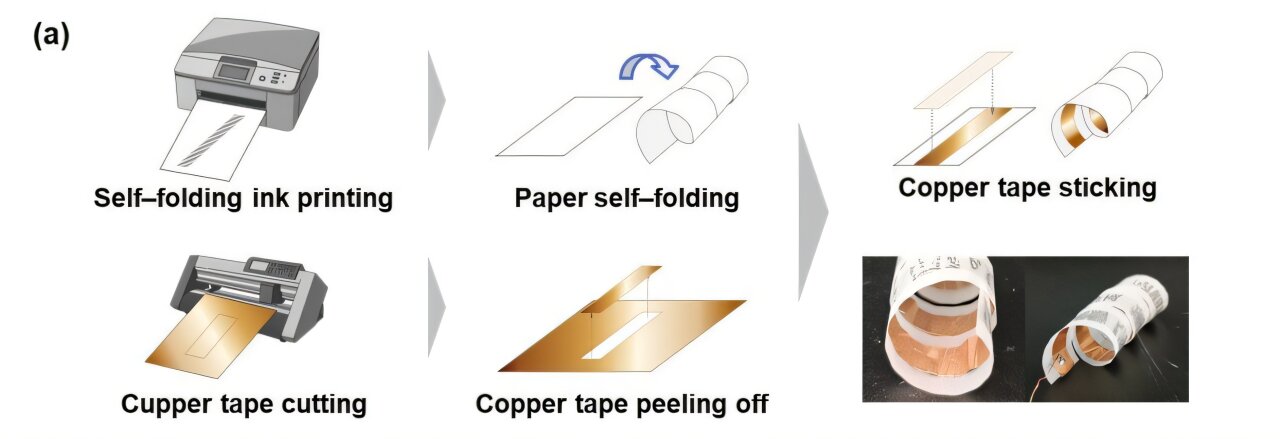
Now, a team of researchers led by Hiroki Shigemune, an associate professor in the College of Engineering at Shibaura Institute of Technology in Japan, along with Yugo Takashima of Shibaura Institute of Technology in Japan, has developed a parametric design tool that transforms flat sheets of paper into self-folding, helical wearable sensors.
The new approach, which integrates copper tape electrodes, allows sensors to automatically conform to the desired dimensions of a body part without straps or adhesives and can help measure biosignals.
The study was published in Advanced Sensor Research on July 1, 2026.
"We were inspired by the way climbing vines naturally wrap around supports in a helical form and adapt to their shape. By combining this concept with our paper self-folding technology, we developed a parametric design tool that converts the desired dimensions of a body part, such as finger, wrist or arm, into a printable 2D pattern to generate a customized self-folding paper wearable device," Shigemune said.
Source link