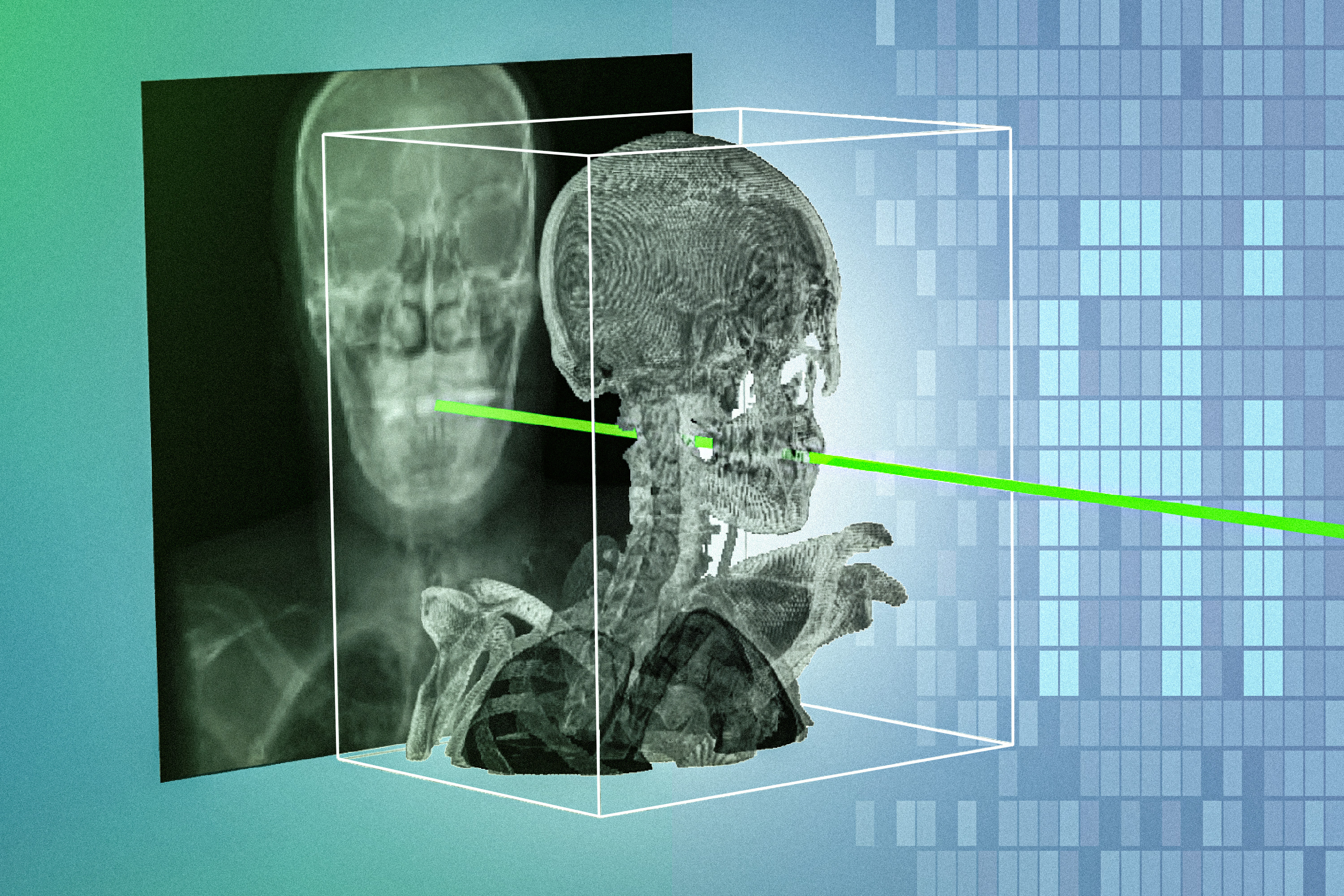
Researchers created a new technique that accurately and rapidly matches X-rays captured during surgery with a patient’s preoperative 3D medical scan. This method could make it easier for clinicians to precisely pilot minimally invasive surgical tools, leading to faster and safer procedures.
Clinicians perform many minimally invasive surgeries using real-time X-rays to help them steer devices like catheters and endoscopes through tiny incisions. But since X-rays are flat images, it can be challenging to determine exactly where surgical tools are located and oriented within the patient’s body, increasing the risk of complications.
To help localize surgical devices, clinicians may manually align X-rays with preoperative 3D medical images, such as CT scans or MRIs. Artificial intelligence tools designed to streamline this process struggle to align images robustly for all patients, making them infeasible in practice.
This new system, developed by scientists and clinicians at MIT and collaborating institutions, uses an AI model that adapts to each patient in only about five minutes. The model automatically matches one patient’s X-rays with 3D scans in a matter of seconds, and with sub-millimeter precision.
Named xvr (which stands for X-ray volume registration), it outperformed existing AI methods by an order of magnitude across a wide range of patients, body parts, and medical procedures.
“A majority of Americans live more than an hour away from a center that can perform noninvasive procedures, like emergency stroke interventions. An hour in stroke time is incredibly substantial. Making these procedures easier by combining 2D and 3D information enables these types of highly specialized life-saving procedures to be more accessible to much broader parts of the population,” says Vivek Gopalakrishnan, a postdoc in the MIT Computer Science and Artificial Intelligence Laboratory (CSAIL); a recent graduate of the Harvard-MIT Program in Health Sciences and Technology; and lead author of a paper on xvr, which appears today in Nature .
Source link