In the 1960s NASA began developing a system of reusable space shuttles to make its work more efficient and to reduce costs. The shuttles could launch like rockets, maneuver in Earth’s orbit, and land like airplanes. They also could carry large satellites to and from orbit.
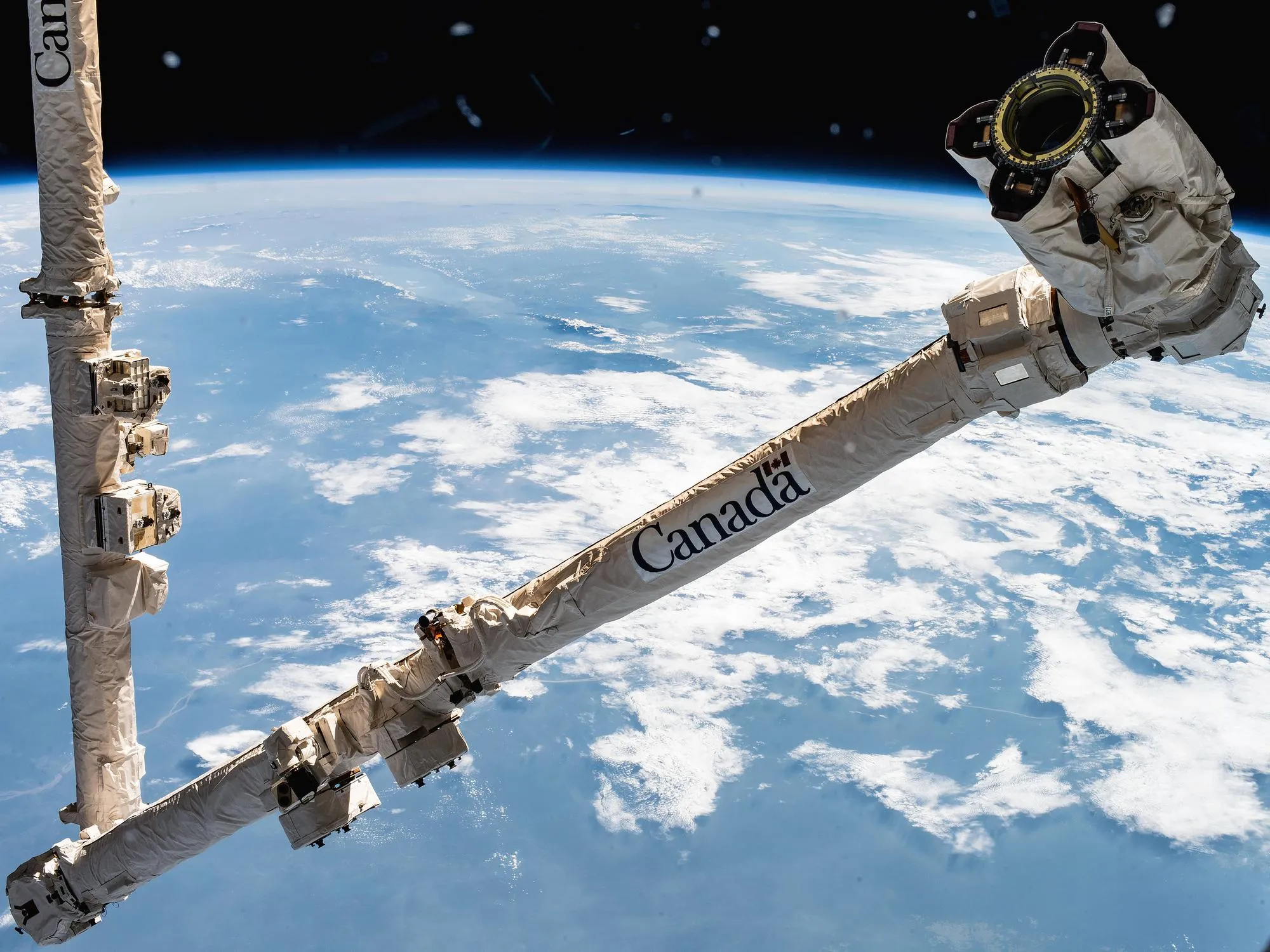
Like other types of transportation, machinery eventually breaks down, and parts need to be replaced or fixed. And the cargo being carried to and from Earth has to be moved to its final destination. To complete such tasks, Spar Aerospace (now part of MDA Space) of Brampton, Ont., Canada, and the National Research Council in Ottawa developed a robotic arm, the Shuttle Remote Manipulator System. The project was a joint venture between the U.S. and Canadian governments.
Known as Canadarms, the robotic tools attached to shuttles’ exteriors. They allowed astronauts to handle and transfer tools, satellites, and other payloads. Inspections of the shuttle and repairs could be completed using the robots.
The system was first deployed in 1981 aboard Columbia’s second flight. Canadarm was used for 30 years on five shuttles and on the International Space Station.
The robotic arm was dedicated on 19 June as the 300th IEEE Milestone. The ceremony was held at MDA Space headquarters. The IEEE Toronto Section sponsored the nomination.
“It is appropriate that the 300th Milestone is the Canadarm,” says Michael Geselowitz , senior director of the IEEE History and Heritage group . “The technology spans aerospace, robotics, and computing fields of interest.
Source link