
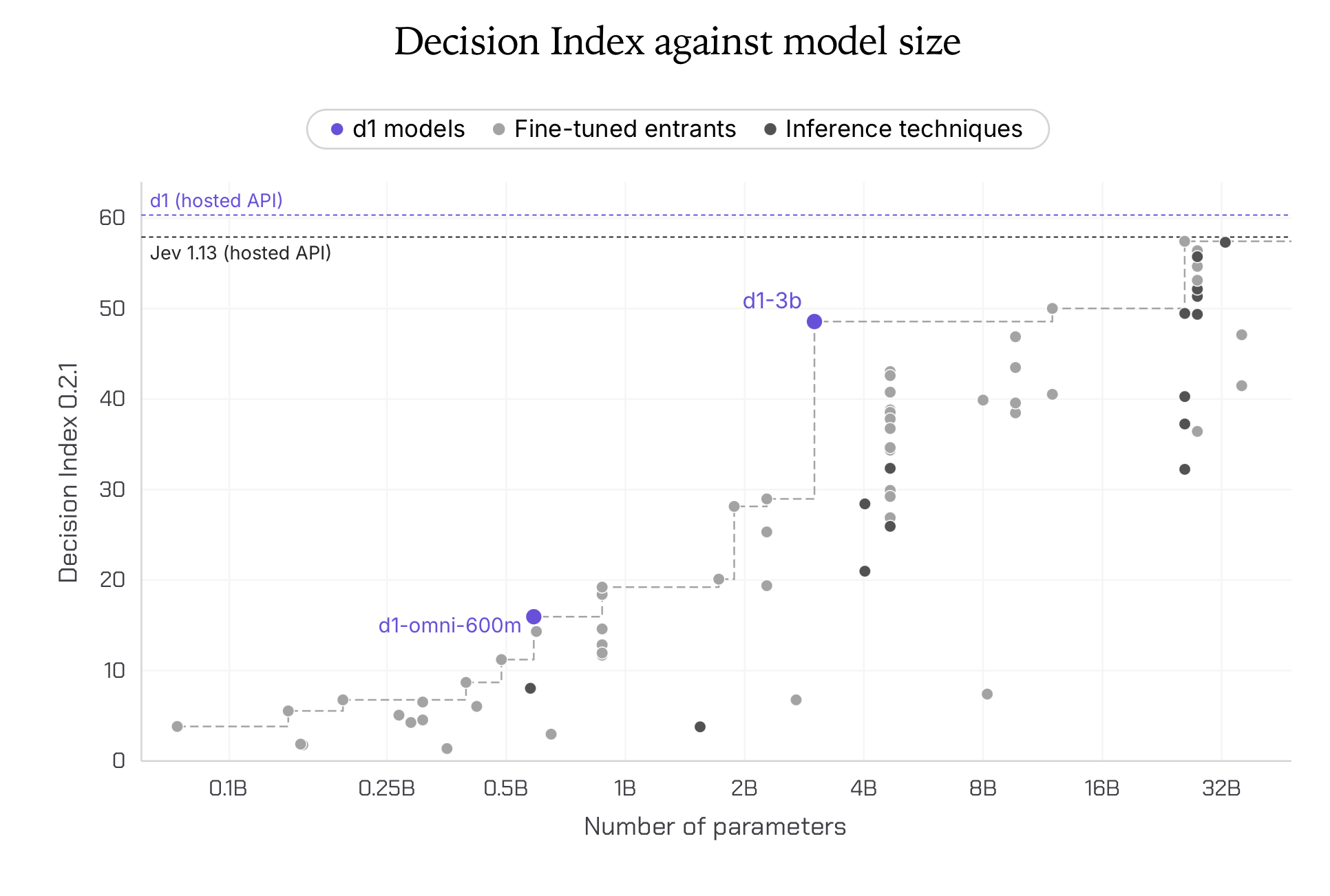
These open d1 decision models are built on our Liquid Foundation Models (LFMs). Unlike our generative models, decision models don’t produce tokens but answer in a single forward pass.
We benchmarked d1-3B and d1-omni-600M on seven public datasets spanning reading comprehension, toxicity detection, intent classification, medical QA, and cross-lingual understanding. d1-3B achieves a mean score of 82.9, the highest in the table and above Decider 4B. d1-omni-600M scores 78.4, surpassing Decider 2B (77.1) with only a quarter of the parameters.
We validated that d1-3B retains the vision capabilities of its LFM2.5-VL-3B backbone on standard vision benchmarks, and that d1-omni-600M handles all three modalities. We do not report any vision or audio benchmarks, as the Decision Index v0.3 includes only a private vision split and audio decision benchmarks are currently an open problem.
In collaboration with NVIDIA, we evaluated d1-3B on the NVIDIA stack across NVIDIA GeForce RTX 4090, NVIDIA Jetson AGX Thor, Jetson AGX Orin 64 GB, and Jetson Orin Nano. Since d1-omni-600M is an early research release, we don’t report any speed numbers for it in this release.
Edge inference. d1-3B answers a single question in under 50 ms on every measured device. Three questions take only 1.3x the time of one, with the AGX Thor going from 16 ms to 20 ms.
GPU inference. On GPU, d1-3B answers a question in under 10 ms and processes a 384px image in under 18 ms on both platforms.
Reach for d1 decision models when you need fast, structured decisions, including multimodal inputs.
Source link





