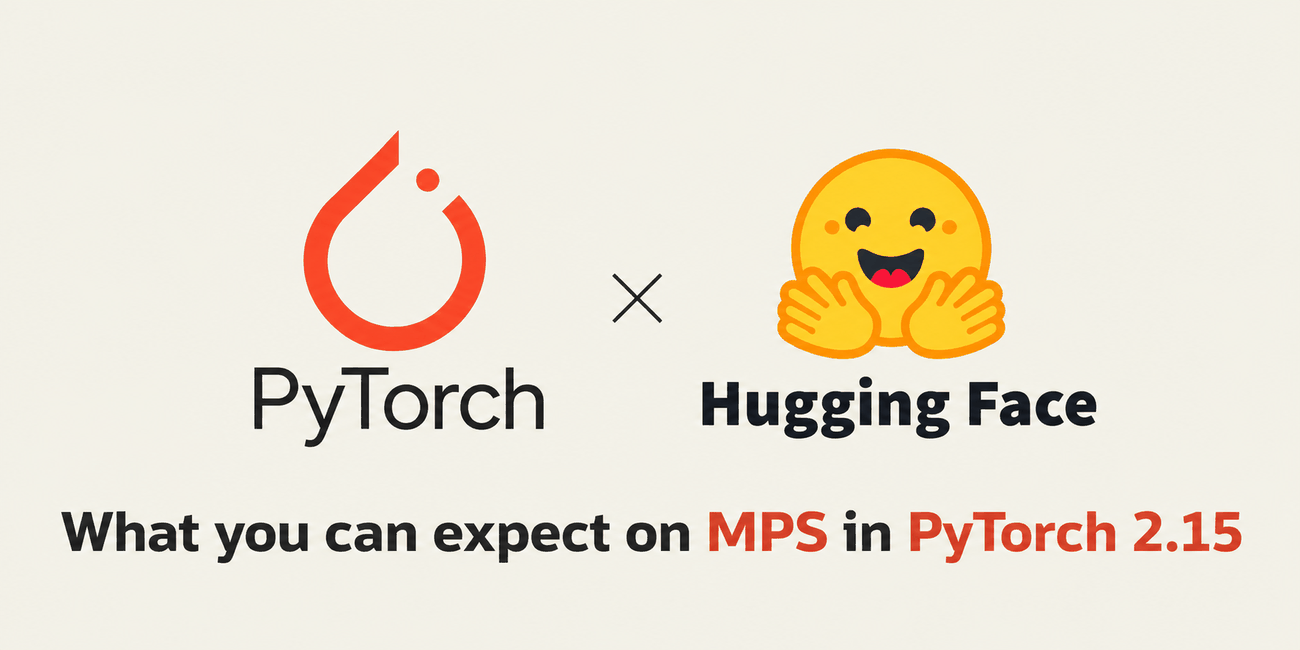
A quick word about who we are: we're the PyTorch team at Hugging Face. We contribute across PyTorch, and one of our focus areas is the MPS backend, where the goal is to make your Mac a first-class place to run and train PyTorch models. At the start of 2026, running even small models on MPS often meant working around unsupported operations, performance cliffs and unexpected memory growth. So we run real models from the Hugging Face Hub across language, image and video, find where MPS falls short and fix it upstream in PyTorch, more and more often by replacing MPSGraph with dedicated Metal kernels. Much of this post is the result of that work, done together with the PyTorch maintainers and community contributors.
If you run models on a Mac with transformers, diffusers or tools like ComfyUI, here's what 2.15 changes in practice:
You'll need an Apple silicon Mac with macOS 15 or later and Python 3.11 or later (see the 2.15 compatibility matrix). If your OS is too old or no Metal GPU is available, the MPS availability check now tells you why.
FP8 gives you another way to save memory on your Mac. PyTorch 2.15 adds torch.float8_e4m3fn tensors on MPS: one byte per value, half the storage of FP16 or BF16.
You can multiply these tensors with F.scaled_mm, which supports both tensorwise and rowwise scaling. Here's a small example with one scale per tensor:
Every LLM has a prefill phase and a decode phase. During decode, each new token goes through the model as a single row, so the big matrix multiplications turn into matrix-vector products.
Source link