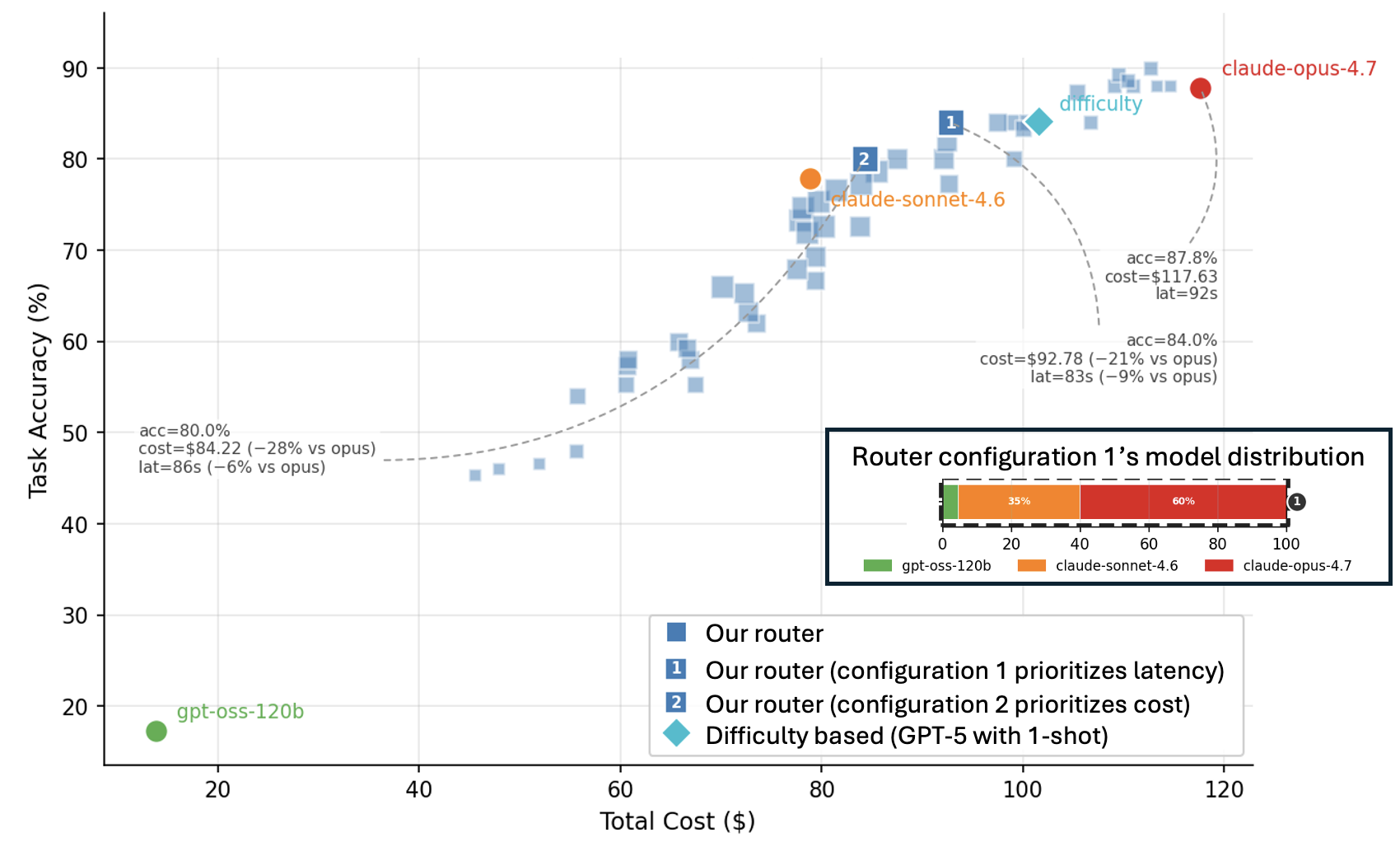
Except it’s not. Most routing systems assume that model selection is a classification problem. In our experience building routing into agentic systems, what looks like a model-selection problem quickly becomes a systems optimization problem. Three dimensions made this surprisingly hard for us.
We expected GPT-4.1 to be cheaper than Claude Sonnet 4.6. It wasn’t.
Across 417 tasks on the AppWorld Test Challenge using the same CodeAct agent, Sonnet cost $79 total ($0.19/task) while GPT-4.1 cost $155 ($0.37/task) — nearly double. On paper, this makes no sense. GPT-4.1’s token pricing is lower on both input and output, and Sonnet takes roughly three times as many reasoning steps to finish the same tasks. By sticker price alone, GPT-4.1 should win easily.
The explanation? Caching — something most routing discussions ignore entirely. Agent workloads tend to reuse large chunks of context across steps. When cache hit rates are high, effective input costs drop dramatically. Sonnet’s lower cache-read pricing meant it benefited disproportionately from this pattern, enough to overcome both its higher base pricing and its longer trajectories.
The takeaway: actual cost depends on the interaction between the model, the workload, and the serving infrastructure. A router that only looks at pricing sheets is optimizing against the wrong numbers.
A common routing strategy is to estimate how hard a task is and send harder tasks to stronger models. Intuitive, but it breaks down in two ways.
First, difficulty is often invisible at routing time. A request like "summarize this contract" looks simple, but might trigger retrieval, compliance checks, tool use, and multiple rounds of refinement before it’s done.
Source link