Can AI determine whether two rooms remain connected after a wall is added? Can it recognize whether an animal is inside a fence, distinguish a true knot from a tangled loop, or rearrange several ropes without allowing them to pass through one another?
These questions concern 3D topology, a form of spatial understanding based not on exact distances, angles, or shapes, but on structural relationships that persist as objects bend, stretch, or deform. Connectivity, enclosure, ordering, and knottedness are examples of topological properties. These properties are a foundational layer of human spatial understanding in Cognitive Science, yet they remain largely absent from how multimodal AI systems are evaluated.
In a new research study, we introduce MindTopo (opens in new tab), a benchmark designed to evaluate whether multimodal large language models possess this kind of topological intuition. Our findings reveal a substantial gap between recognizing topology in a static image and maintaining an innate understanding of that topology while planning and acting. Current models can sometimes identify a connected path, enclosed region, or knot in a single scene, but that understanding often breaks down once the model must manipulate the scene through a sequence of actions.
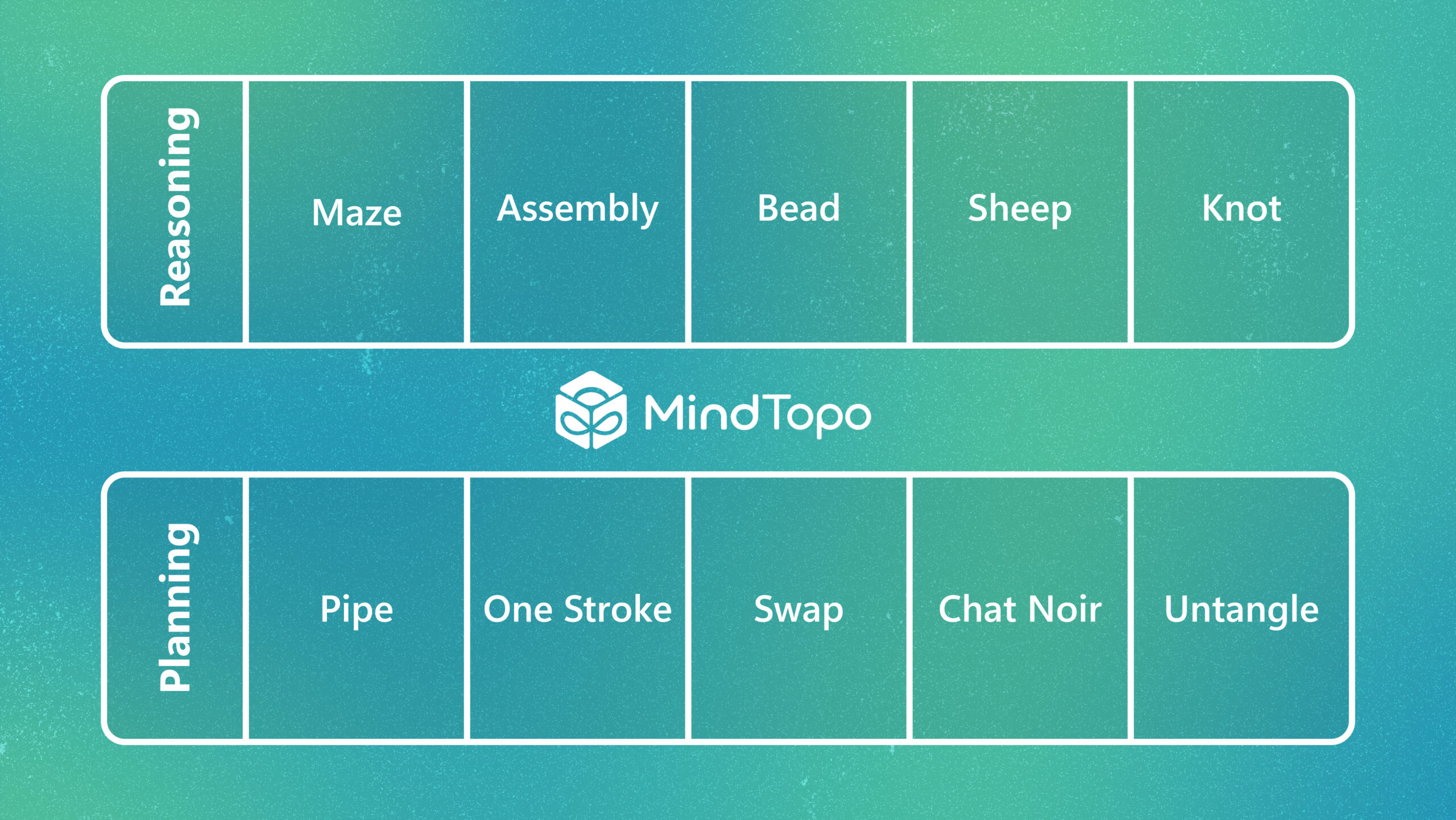
Most spatial evaluations for multimodal models focus on Euclidean properties such as distance, direction, size, and relative position. Inspired by Piaget and other cognitive literature’s classification of topological ability, MindTopo organizes its tasks around the following five categories:
Each category is evaluated at two cognitive levels. In reasoning tasks, a model examines one or more rendered scenes and answers a question about their topological structure: whether two points in a maze are connected, whether the sheep are inside the fence, whether a rope is truly knotted.
Source link