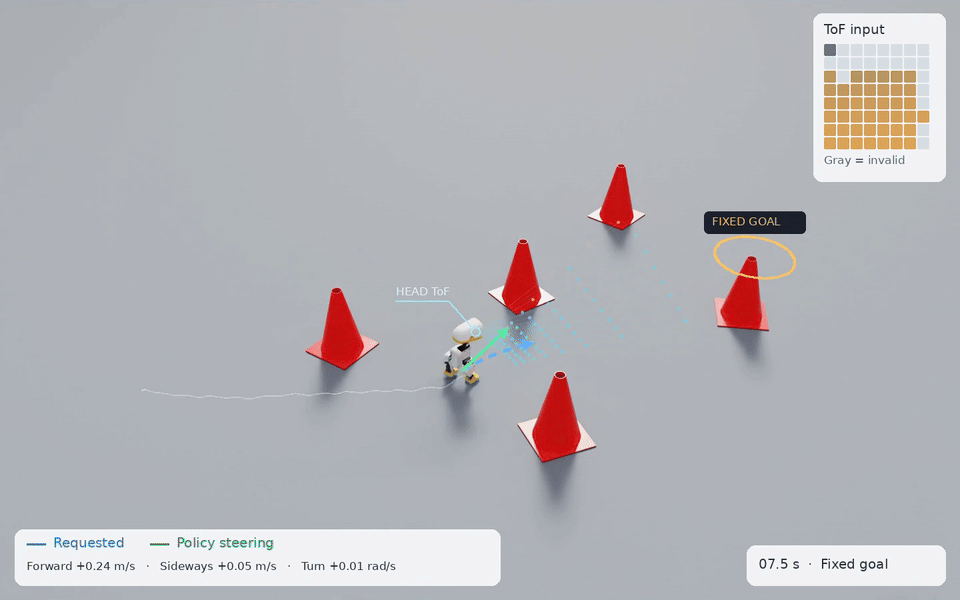
Add local obstacle avoidance to Microduck while keeping its walking policy fixed. Build varied courses with reusable SimReady assets, model ToF sensing with Newton’s raycaster, and train a controller in Isaac Lab to adjust gamepad velocity commands around obstacles. This tutorial covers simulation training, evaluation, export, and real-robot deployment.
A walking policy can keep Microduck balanced, but it does not tell the robot how to steer around an obstacle in its path. In this workflow, we reuse the walking policy from our first Microduck tutorial and keep its weights fixed. This follow-up trains a separate avoidance controller using time-of-flight (ToF) sensing. You choose a direction with a gamepad; the controller adjusts the velocity command before passing it to the walking policy.
NVIDIA Isaac Lab is an open-source framework for training policies across thousands of GPU-parallel simulations and it provides the robot-learning environment. Newton simulates physics and the sensor’s depth measurements. We will cover the control architecture, train on varied obstacle layouts, evaluate the resulting policies, and prepare the interface for hardware testing.
A Linux system with a compatible NVIDIA GPU and driver. See the Isaac Lab installation guide for platform requirements.
A configured Microduck. Load the same backlash walking-policy export used by the navigation task.
Install uv if it is not already installed. Then clone the exp/microduck branch of the Isaac Lab repository and install its dependencies:
Download and export the upstream backlash walking checkpoint once before training. The obstacle avoidance task loads the exported walking policy automatically.
The environment combines simple primitives with OpenUSD assets available through SimReady Central on Hugging Face.
Source link