
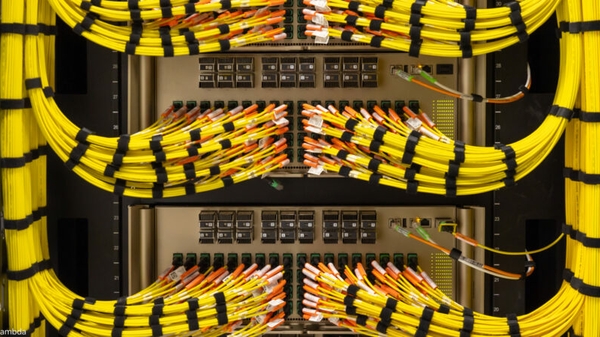
To train an AI model, thousands of GPUs have to work together, requiring a network that’s fast, efficient and resilient.
Lambda is tackling the network piece of the puzzle with NVIDIA Photonics co-packaged optics (CPO) switches. The cloud provider is using the switches to connect NVIDIA GB300 NVL72 racks with more than 10,000 GPUs, delivering lower power, higher resiliency and longer mean time between interruptions (MTBI) to an AI factory at scale.
“Networking has to keep pace with the demands of increasingly large AI clusters,” said Dave Ward, president of cloud services at Lambda. “Bringing co-packaged optics into a deployment of this scale is an important step toward building the infrastructure needed to support the next generation of AI.”
In the company’s tests using the switches, network latency — the time needed for moving data — dropped by about 4% at rack scale and by up to about 10% at pod scale. Across rack, scalable unit and pod configurations, the network maintains the same throughput as conventional pluggable optics.
Improving power efficiency and resiliency matters because the network sits at the center of AI factory productivity.
In a large training job, one interrupted link can stall thousands of GPUs. With agentic inference, one network disruption can introduce cascading latency effects on many agents. Every interruption costs time, and every watt spent on networking is a watt not available for compute.
NVIDIA Photonics addresses both power efficiency and resiliency. By replacing pluggable transceivers with co-packaged optical engines on the switch package, it delivers up to 5x better power efficiency and up to 15x higher reliability than conventional pluggable optics.
Source link





