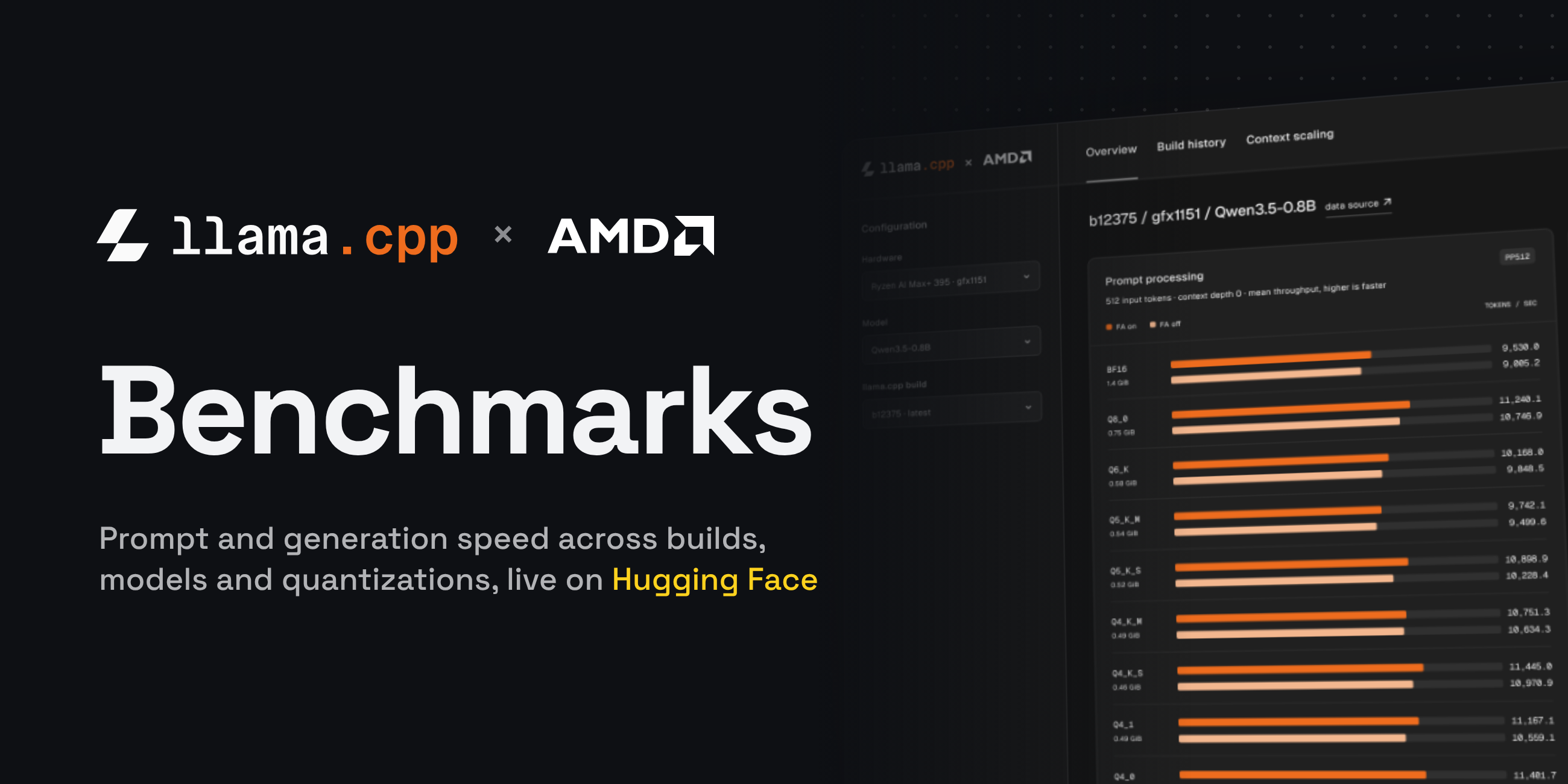
The llama.cpp × AMD Benchmark dashboard is available on Hugging Face. It lets you track prompt processing and text generation performance across llama.cpp builds, models, and quantizations, so you can explore how local inference performs on AMD Ryzen and Radeon hardware.
Local inference performance changes as models, kernels, and builds evolve. We want those changes to be easy to inspect for any AMD developer: pick a hardware, a model and a build, compare quantizations, and follow performance over time. The benchmark workflow and underlying results are public, so you can also inspect how we benchmark inference performance.
You can choose Hardware, Model, and llama.cpp build in the Configuration sidebar. The current hardware choices are Radeon 8060S (gfx1151) and Radeon AI Pro R9700S (gfx1201).
The dashboard shows two separate tests, both measured in tokens per second:
Both tests start at context depth zero (n_depth=0). PP512 measures processing 512 input tokens without generation; TG128 measures generating 128 tokens without a pre-existing context. The plotted value is the mean throughput (avg_ts). These are useful reference workloads, while the Context scaling tab lets you explore token generation throughput as the context grows.
We benchmark the prebuilt binaries distributed through llama-install.sh, the build and installation project behind llama.app. The public gfx1151 and gfx1201 workflows are scheduled weekly and run the standard benchmarks using the llama-bench tool with Flash Attention on and off, with 10 repetitions per configuration.
The model set evolves and currently includes Inkling 2 Mini, Qwen, Gemma, gpt-oss, and LFM models, covering both dense and mixture-of-experts architectures.
Source link