
Your browser doesn't support HTML5 video. Here is a link to the video instead.
Turning a simulation idea into a working application means assembling assets, connecting physics and rendering, and checking that the scene behaves as intended. Developers are combining frontier AI models with NVIDIA Omniverse libraries to help carry out that work — building applications for exploring scenarios, investigating failures and improving designs.
Developers direct AI agents through natural-language instructions, review results and guide changes. Omniverse libraries provide GPU-accelerated physics, rendering and sensor simulation capabilities.
Explore the projects below to see frontier AI models such as GPT-6 Astra at work, and check back for new examples from NVIDIA teams and developers across the ecosystem.
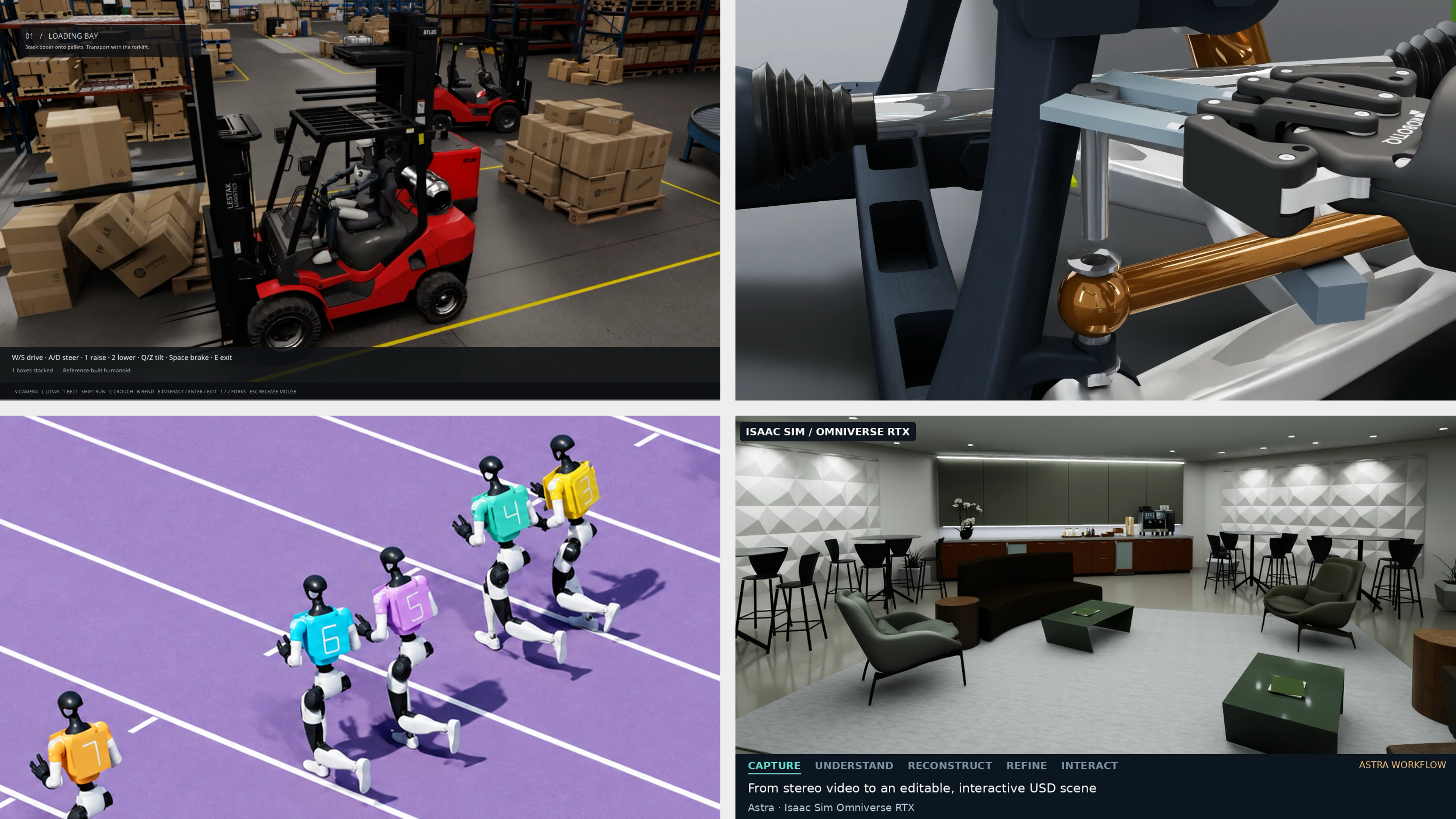
Explore a gamified, physics-based control of a humanoid robot in first- and third-person view.
Before automating warehouse tasks, developers need an interactive simulation environment to explore task behavior and evaluate how the work gets done. Frank DeLise, Omniverse product manager at NVIDIA, used Astra to turn a SimReady warehouse and humanoid robot into an interactive simulator with first- and third-person views.
DeLise directed Astra to connect NVIDIA Omniverse libraries for physics (ovphysx), scene updates (ovstage), rendering (ovrtx) and the user interface (ovui). He also used Astra with SimReady (simready-foundation) to create the physical scene in simulation. Astra then generated animation and application code to bring those capabilities together.
Learn how to prepare and validate SimReady robot assets with frontier AI models and NVIDIA Omniverse libraries.
Source link





