This article has been reviewed according to Science X's editorial process and policies. Editors have highlighted the following attributes while ensuring the content's credibility:
MIT researchers have overcome a major challenge holding back the real-world deployment of microwave quantum technologies for advanced signal processing and secure communications.
The team developed a scalable platform that generates pairs of highly correlated radio-frequency waves without the need for bulky, expensive cooling equipment. In quantum technologies, these linked radio waves can be used for noise-resilient communication or high-precision radar and sensing. However, they're usually generated only in research labs under extremely cold conditions.
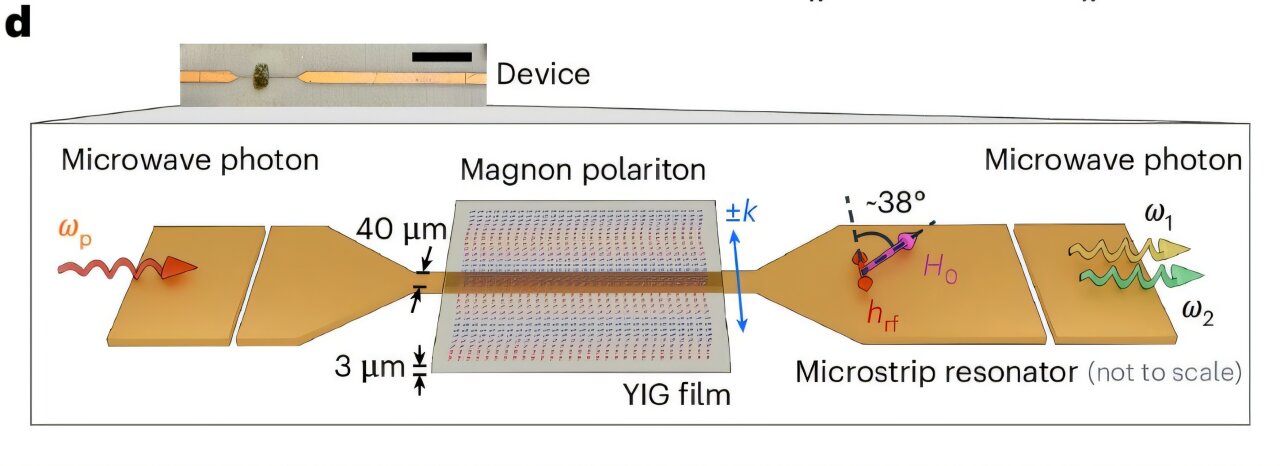
The MIT researchers fabricated a small electronic device that can generate the same type of highly correlated signals at room temperature.
The device incorporates a magnetic film, which interacts with microwave energy inside a metal cavity to split an incoming signal into two linked output signals. The researchers used the device to demonstrate secure communications by encoding information in a signal that could only be recovered using its partner signal.
"We've shown how the quantum properties of magnets can be leveraged to realize new communication and detection technologies. I hope our demonstration of this platform will enable further development of room-temperature quantum simulators, which have huge potential to enable many future discoveries," says Qiuyuan Wang, an electrical engineering and computer science (EECS) graduate student and lead author of a paper on this technique.
Wang is joined on the paper by Aravind Karthigeyan, a graduate student at the University of Illinois at Urbana-Champaign; Chung-Tao Chou, an MIT postdoc; and senior author Luqiao Liu, an associate professor in EECS and a member of the Research Laboratory of Electronics.
Source link