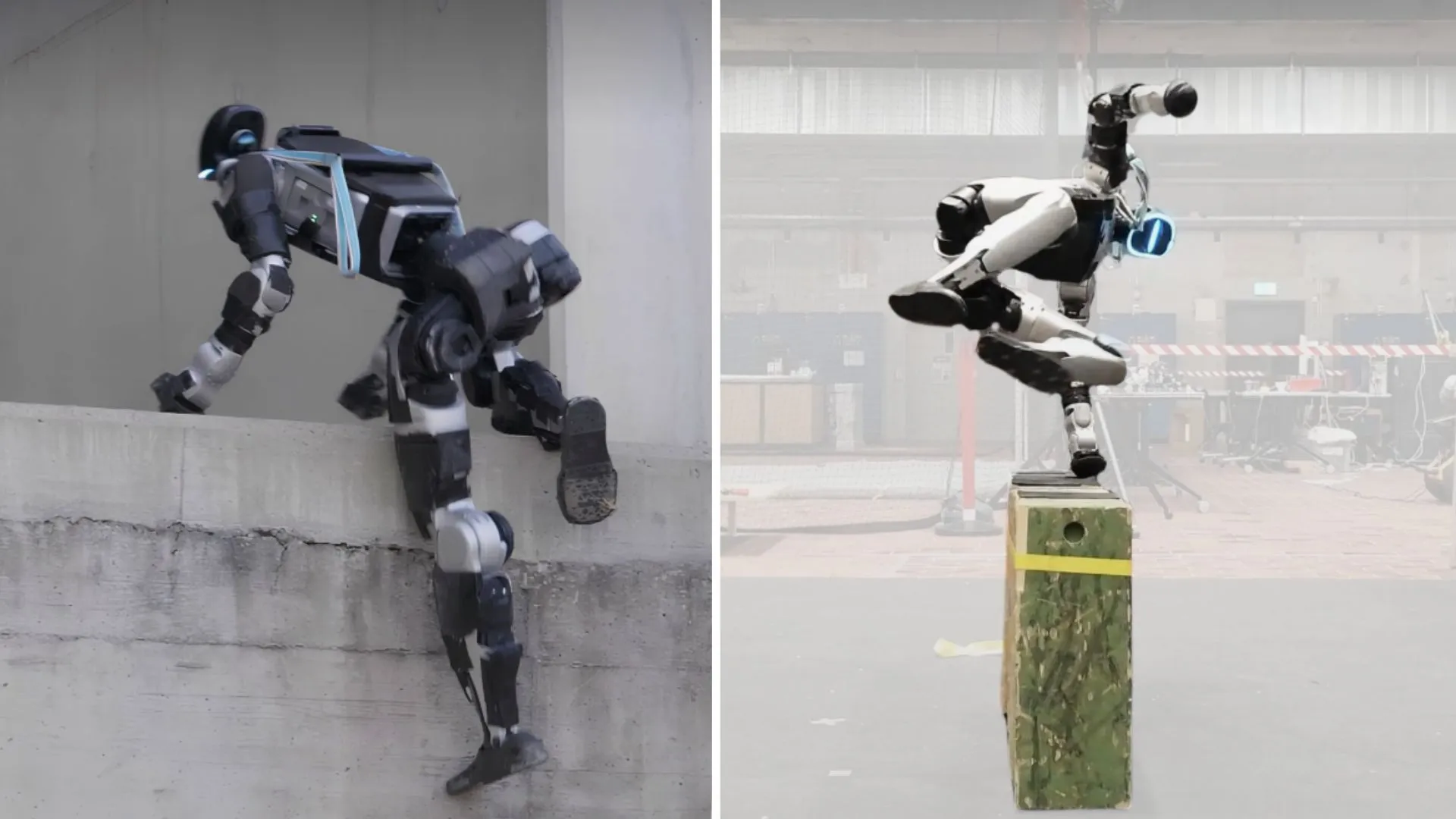
Researchers at ETH Zurich and collaborators developed a control approach that lets a humanoid robot climb ladders, cross obstacles, and recover from falls using a single learned policy.
The system was demonstrated on Unitree’s G1 humanoid robot, showing how one approach can support different challenging movements.
The method focuses on planning contact with the environment, rather than prescribing every movement in advance.
In simulations, the approach achieved higher success rates than a comparison method across eight obstacle courses, highlighting its potential for improving humanoid robot mobility.
The new system lets a humanoid robot climb ladders, cross obstacles, crawl through confined spaces, and recover from falls using a single learned policy.
The technology, called Attention-based Contact Planning (ACP), helps the robot decide where to place its hands, feet, knees, elbows, and pelvis against the surrounding environment.
The system was tested on Unitree’s G1 humanoid robot, demonstrating how contact planning and reinforcement learning can help robots adapt their movements to different terrain without following predefined motion sequences.
With @JayHe748646 @KehanWen170077 @leggedrobotics , we push humanoid mobility to next frontier.
Achieved by a generalist contact planner + a generalist tracker + a generalized neural mapping, warmstarted from few human data.
Website: https://t.co/Y7cu3D4K4I
Promo Video  pic.twitter.com/ouZQskpZmQ
ACP combines reinforcement learning with motion imitation to address challenges in whole-body robot control. Reinforcement learning allows robots to improve through repeated attempts and feedback, while motion imitation teaches them to follow recorded movements. However, reinforcement learning can struggle with complex coordination, and imitation-based systems may struggle to adapt to unfamiliar obstacles.
Source link