As memory technologies continue to scale, manufacturing processes are becoming increasingly complex.
Additional process steps, tighter process windows, and new sources of variation are making it progressively more challenging to reach acceptable yield.
Systemic failures are emerging as a source of yield loss during yield ramp. Unlike random defects, these failures are often driven by complex interactions between multiple process modules.
Rapid root-cause identification of these systemic defects is critical to quickly improving yield and accelerating time-to-market.1 But conventional failure analysis relies heavily on wafer experimentation and statistical analysis, which can be slow and costly as manufacturing complexity increases.
Fig. 1: Systemic failures are a key bottleneck during yield ramp. Faster identification and reduction of these failures can accelerate the yield ramp and shorten the time required to reach a targeted manufacturing yield.
Process engineers use virtual manufacturing models (SEMulator3D) with machine learning (ML) optimization (Fabtex Yield Optimizer) to predict process failures.
Using this technique, engineers can evaluate potential yield improvements, all with limited need for wafer-based experimentation.
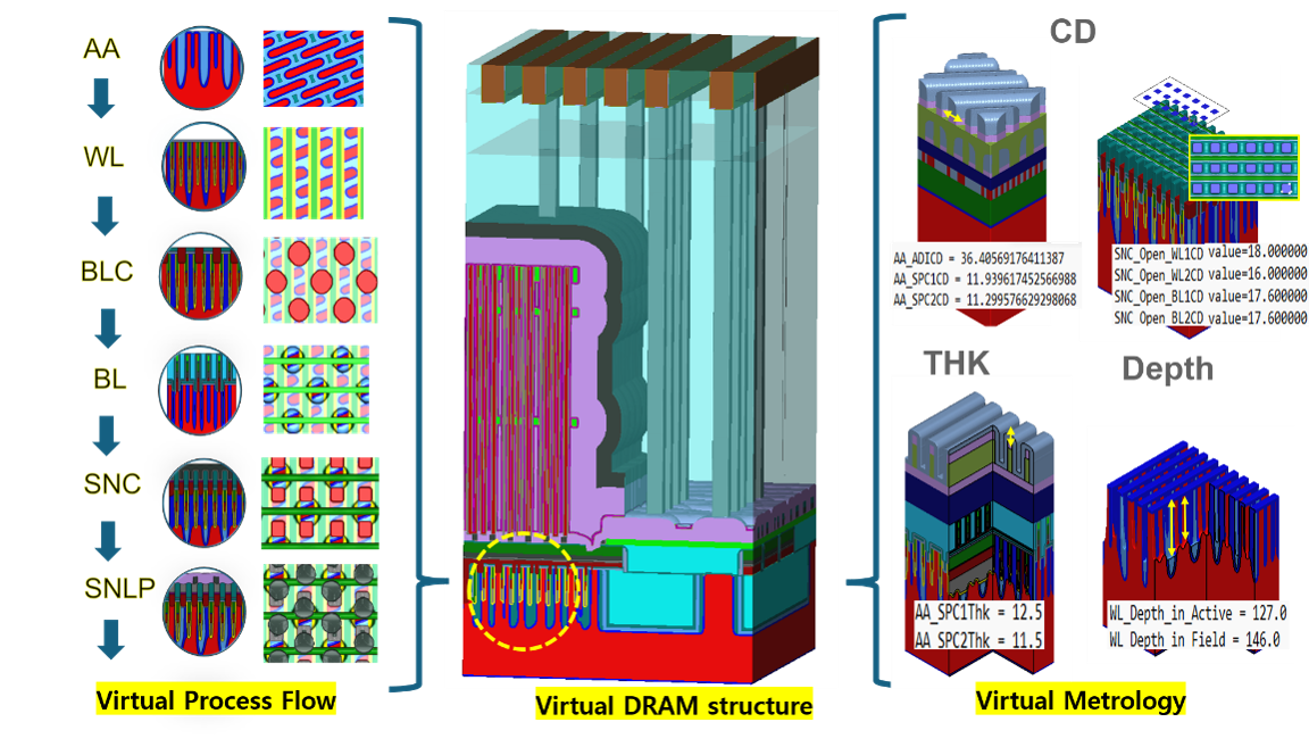
As an example of this technique, we built a SEMulator3D model (virtual twin) of a DRAM manufacturing process sequence. During this model-building, we established virtual metrology measurements throughout the process sequence (Figure 2).
Fig. 2: Building and calibrating a DRAM virtual twin using process integration, virtual metrology, and silicon data.
ML was then used to calibrate the model against silicon data, enabling the virtual environment to better reproduce observed manufacturing behavior and serve as the foundation for downstream failure analysis and optimization.
Source link