MuJoCo Warp (MJWarp), built on NVIDIA Warp, takes compatible MuJoCo models into that GPU-scale regime. In this article, we will move an SO-101 follower arm from a familiar MuJoCo workflow to as many as 2,048 parallel MJWarp environments and examine the technology and validation steps that make the transition possible.
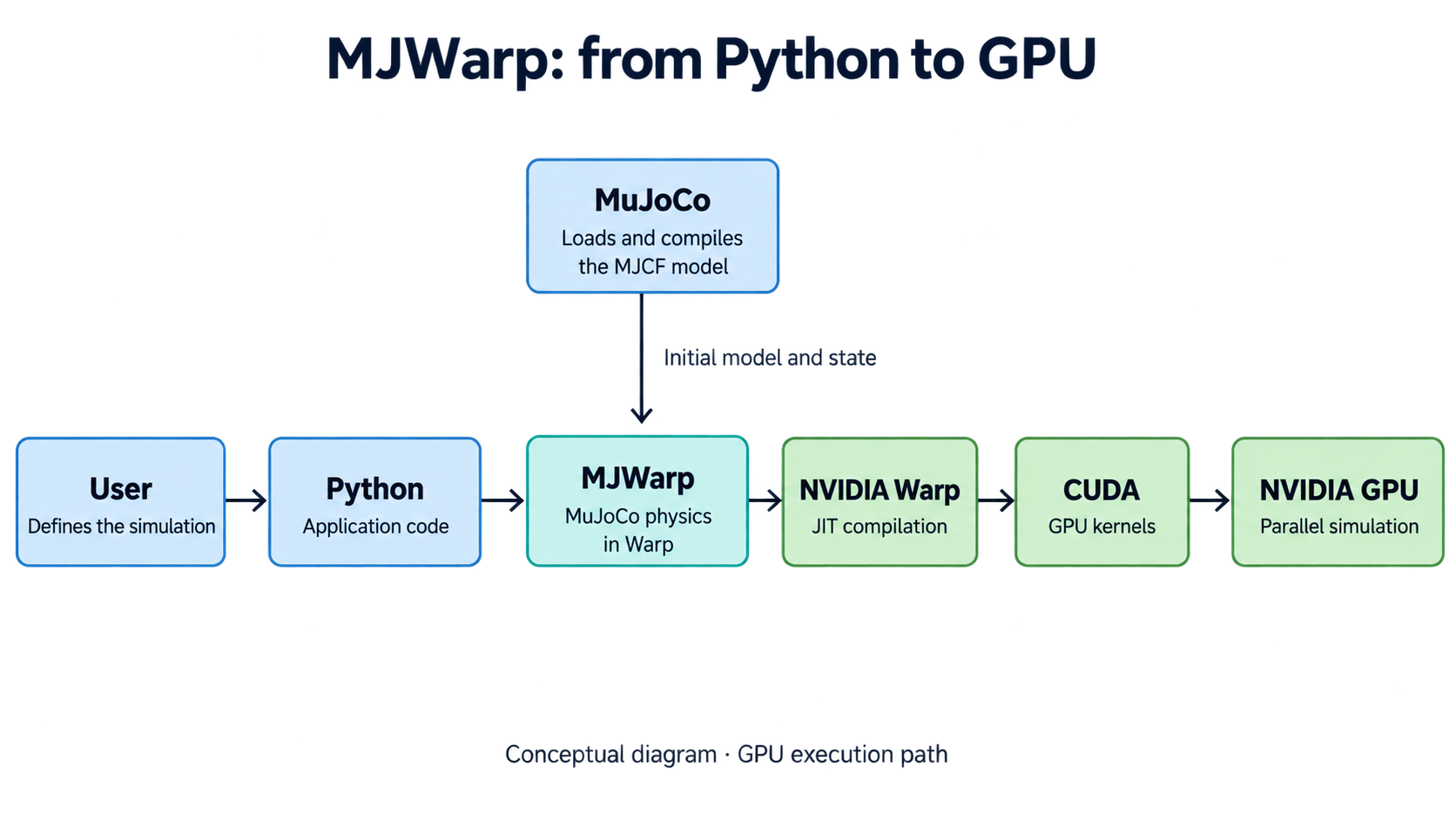 Figure 1. How MJWarp connects Python to GPU simulation. MuJoCo loads and compiles the MJCF model; MJWarp implements the physics in NVIDIA Warp, which compiles CUDA kernels to advance simulation states on NVIDIA GPUs.
This is the second article in our State of Simulation for Physical AI series. The first article mapped the robot-simulation landscape. Here, we prepare and scale the simulation environment; we do not train a policy. The later Newton and Isaac Lab installments cover the next integration layers.
NVIDIA Warp is a Python framework for writing high-performance, GPU-accelerated kernels. Warp lets developers author statically typed kernels in Python and compiles them for CPU or CUDA execution. The first launch builds and caches a native module; later launches reuse it. The kernel language is a performance-oriented subset of Python, while ordinary Python remains responsible for configuration, allocation, and launch orchestration.
This small robotics-oriented kernel advances point positions under gravity. One logical thread handles one point, so the same code scales from two points to millions without introducing GPU terminology into the control flow.
Two further Warp capabilities are worth knowing, even though neither is used in the SO-101 workflow in this article. Tape records the forward kernel launches made inside its context and replays their adjoints in reverse when backward() is called, which is why teams build differentiable geometry, CFD, and custom physics in Warp, including CAE workflows for simulation and design optimization.
Source link