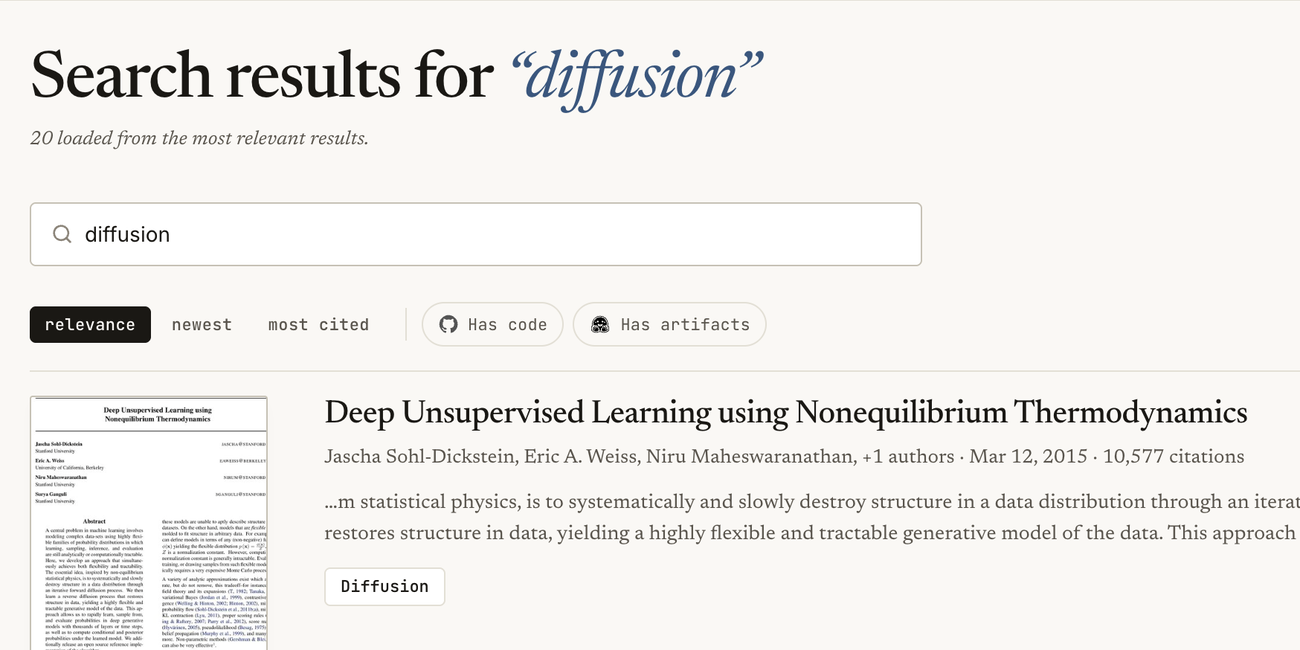
Of course, making AI research accessible requires a powerful search engine, so that humans and agents can quickly find relevant and related work, either through the website or the pwc search CLI command, which agents can use via the Skill.
It's important to note that searching for research is not quite the same as searching for regular text. A useful paper search engine should find an exact title or arXiv identifier, but it should also understand a query such as “small language models for code generation” even when those words do not appear together in a paper. It needs to recognize that “the original BERT paper” is a navigational request, tolerate an incomplete title or typos, and still respond quickly when a model service is cold or temporarily unavailable.
For Papers with Code, we built this as a hybrid search system. This is also based on our prior experience at ML6, where we developed RAG-based systems for clients. It turned out that hybrid search typically outperforms keyword- and vector-based search systems, as it combines the best of both worlds (see also this blog for more info). Keyword search finds exact mentions, whereas vector search finds more fuzzy, semantically similar terms. Note that rerankers (also called cross-encoders) can further improve the results, although they also come with additional overhead and latency.
Papers with Code relies on a PostgreSQL database, hence its full-text search capabilities provide a fast lexical baseline. For dense embeddings, pgvector is used to add semantic recall, and the reciprocal rank fusion (RRF) algorithm combines the two.
Source link