The age of physical AI is here, and with it comes a significant increase in the demand of custom silicon.
By 2025, five million industrial robots were operating worldwide. As these systems become more capable, their demands on silicon become more distinct. Each must balance computation and memory with the realities of power, latency, reliability, and security.
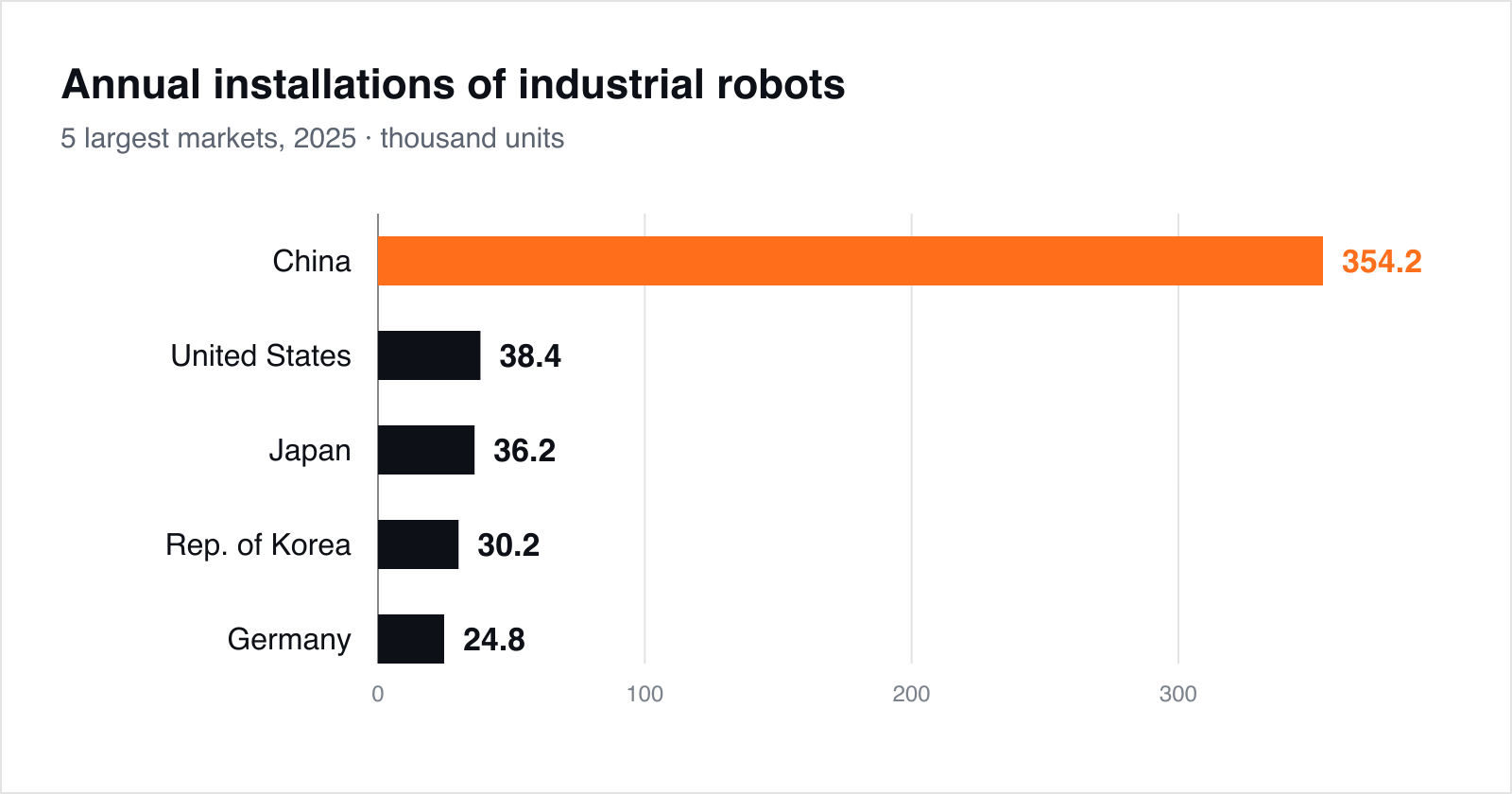
Fig. 1: Annual installations of industrial robots, 5 largest markets, 2025. Source: International Federation of Robotics, World Robotics 2026. Chart redrawn by ChipAgents.
For humanoid robots in particular, application-specific hardware can provide the agility and speed required to perform specialized tasks in real time. As those requirements diverge, specialized ASICs become more attractive, because they can be optimized for the exact workloads, latency targets, power envelopes, and operating environments of a particular system.
The constraint to this innovation is development speed: AI models and software evolve faster than the conventional silicon tape out cycles, creating a need to accelerate the entire path from design intent and exploration to physical implementation and validation.
For agentic AI to deliver that acceleration, it must meet three requirements.
Agents need a shared, persistent representation of the design and the engineering knowledge behind it. A design ontology provides structure: it connects design flows, RTL design, verification, verification tools, error diagnosis and repair, synthesis, timing, and PPA optimization methodologies. Organization-specific methodologies and prior decisions add the rationale for how the design should evolve. To remain useful across tasks, this context must track provenance, design versions, and dependencies, so agents can distinguish current evidence from assumptions or superseded results.
Source link