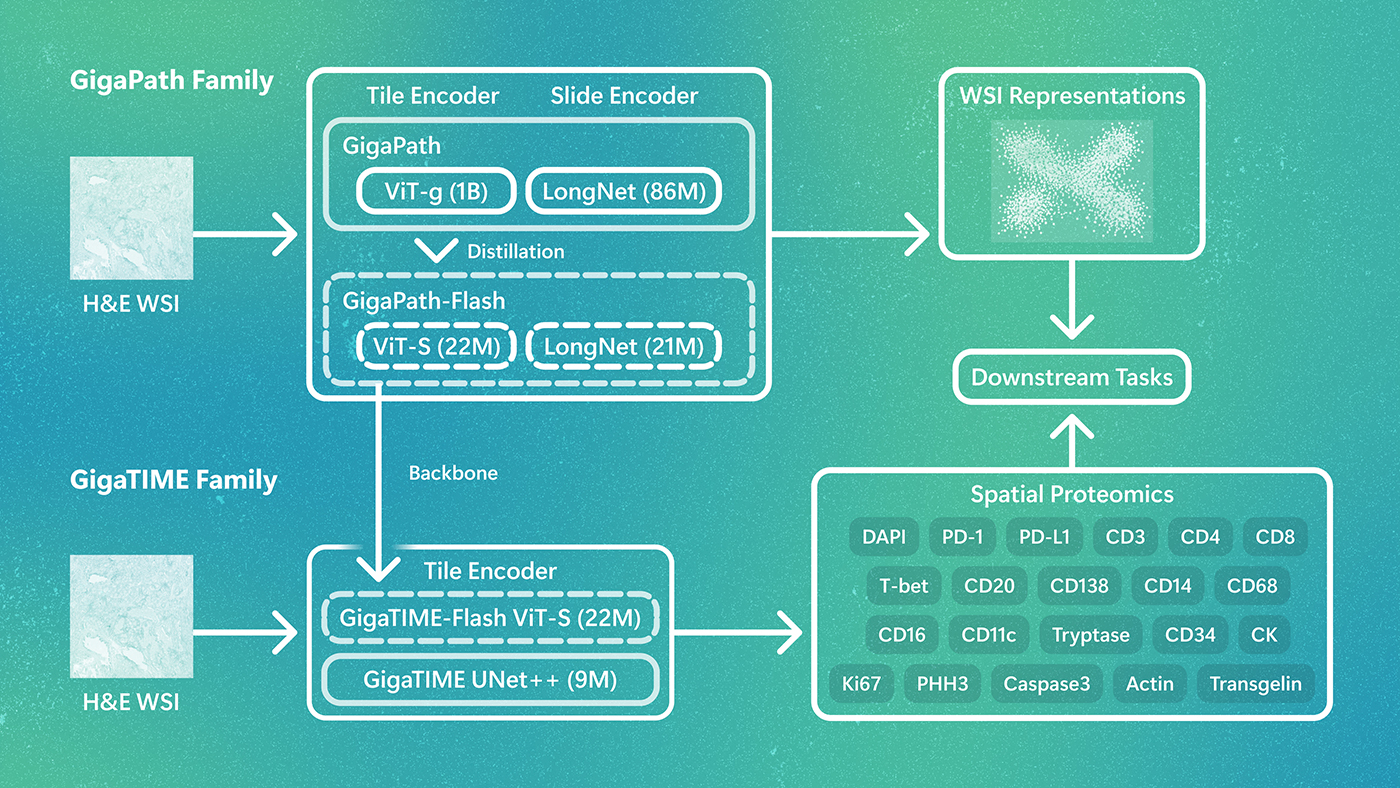
GigaPath (opens in new tab) and GigaTIME (opens in new tab) demonstrated how foundation models can support whole-slide analysis and tumor microenvironment modeling from routinely collected pathology data. GigaPath-Flash and GigaTIME-Flash make these capabilities substantially more efficient, enabling researchers to analyze larger cohorts, run more experiments, and move toward population-scale discovery. GigaPath-Flash and GigaTIME-Flash are research models. They are not intended or validated for clinical use, including diagnosis, prognosis, treatment selection, or other patient-care decisions. Performance may vary across datasets, scanners, institutions, populations, and use cases.
Histopathology is among the richest and most widely available sources of information in cancer research. Every tissue biopsy produces a whole-slide image that captures cellular morphology at subcellular resolution — and hospitals generate millions of these slides each year. This data contains information relevant to diagnosis, prognosis, treatment selection, and the biology of the tumor microenvironment.
Foundation models have begun to unlock this information at scale. But whole-slide images are large — often exceeding a gigapixel — and applying a foundation model to even a single slide requires processing thousands of image tiles. When a research question involves tens of thousands of patients, the computational cost grows quickly. And population-scale discovery is not a single model run: it requires repeated cycles of feature extraction, statistical analysis, hypothesis testing, and validation across patient subgroups, biomarkers, and clinical endpoints.
Computational cost limits the number of patients, datasets, tasks, and hypotheses that researchers can study. To realize the full potential of pathology foundation models, we need models that can be applied repeatedly and affordably across large patient populations.
Source link