
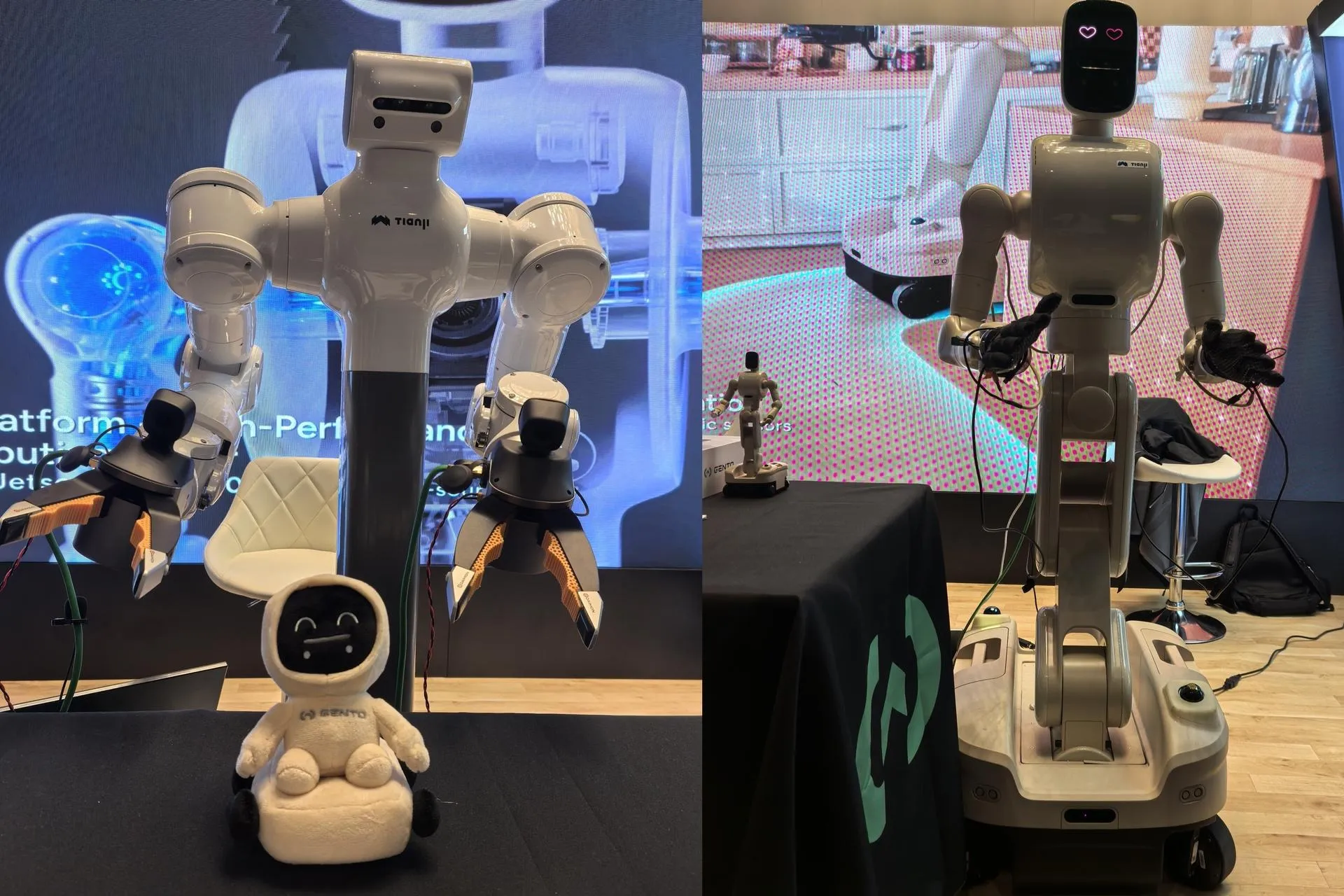
Robot hands have become one of the busiest corners of humanoid robotics. In recent months, companies have taken very different routes toward useful dexterity, from Boston Dynamics’ four-finger, 13-DoF hand for Atlas to 1X’s 25-DoF tendon-driven hands for NEO.
GENTO, an independent humanoid robot brand incubated by Tianji Intelligence, has now put its own design on the table.
GENTO showed its 21-degree-of-freedom (DoF) dexterous-hand prototype for the first time at the Conference on Robot Learning (CoRL 2026). The hand was on static display at GENTO’s Booth 602 at the JW Marriott Austin.
Rather than leading with a single headline figure, GENTO built the hand around four mechanical problems that tend to show up together in dexterous hands. These are backlash, damage from impacts and overloads, joints that resist being pushed back, and weak fingertip force in small fingers.
The prototype has five active degrees of freedom in the thumb and four in each of the other four fingers, giving the thumb one more degree of freedom than each of the fingers.
According to the product specifications, the hand weighs 750 g (1.65 lb) excluding cables and measures 200 × 96 × 45 mm (7.9 × 3.8 × 1.8 in).
It has a maximum grasp diameter of 100 mm (3.9 in), a rated fingertip force of 10 N, and a minimum opening and closing time of 0.5 seconds.
Repeat positioning accuracy is ±0.05 mm. The hand connects over industrial Ethernet and runs on DC 36–60 V.
The first problem is backlash, the small amount of slack in a transmission that lets a finger drift from where it was told to go.
Source link





