Modern AI and HPC devices are challenging traditional test architectures. As scan data volume, core counts, chiplet integration, and test coverage requirements continue to increase, conventional DFT methodologies are becoming difficult to scale. Synopsys TestMAX Unified Compression, based on DFTMAX SEQ, and Streaming Fabric (SF), a programmable high-bandwidth test data delivery network, provide a new approach that enables scalable, hierarchical, and efficient testing for the next generation of AI compute systems.
These factors are driving exponential growth in test data volume (TDV), routing complexity, tester bandwidth requirements, diagnosis challenges, and overall test cost. Traditional flat scan architectures often struggle with limited test pins, congestion caused by large scan buses, uneven bandwidth allocation, and inefficient utilization of available test resources.
Conventional gate-level DFT methodologies were developed for an earlier generation of SoCs. As designs grow larger, several challenges emerge:
A critical requirement for modern AI chips is the ability to reuse test infrastructure across manufacturing, burn-in, system-level test, and in-field test environments.
Synopsys Unified Compression Architecture addresses this requirement through a comprehensive sequential compression architecture that provides:
Rather than deploying different compression hardware for each phase of the silicon lifecycle, a unified codec can be reused across multiple test modes and environments. This reduces implementation complexity while improving test coverage and diagnosis.
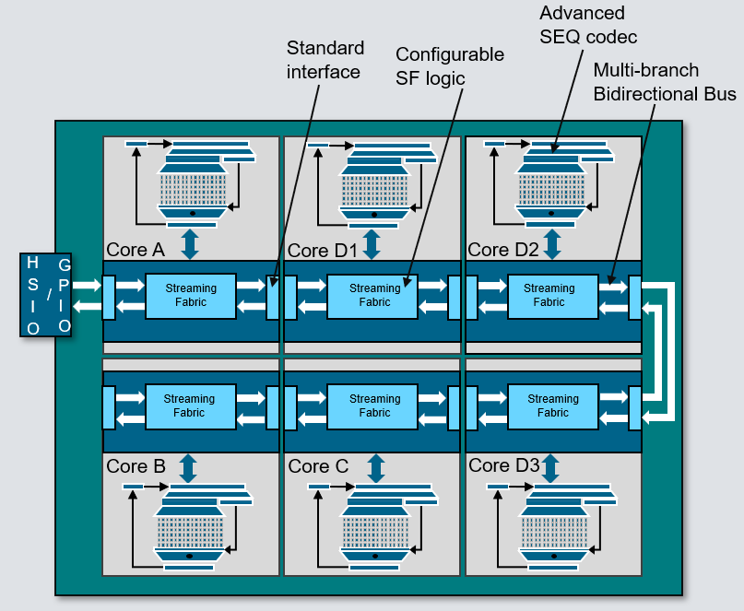
While compression reduces test data volume, efficient distribution of test data remains equally important. This is where Streaming Fabric (SF) becomes transformative.
Streaming Fabric acts as a programmable high-bandwidth data-delivery infrastructure capable of efficiently transporting compressed test data across large hierarchical designs.
Source link