The experience of transitioning from research based in theory to focusing on real-world application can vary significantly for different researchers. However, for two former MIT graduate students and a former postdoc, all now at IBM, working with the MIT-IBM Computing Research Lab (formerly the MIT-IBM Watson AI Lab) during their formative years enabled them to not only close the gap between education and employment, but also to generate ideas promising to business impact.
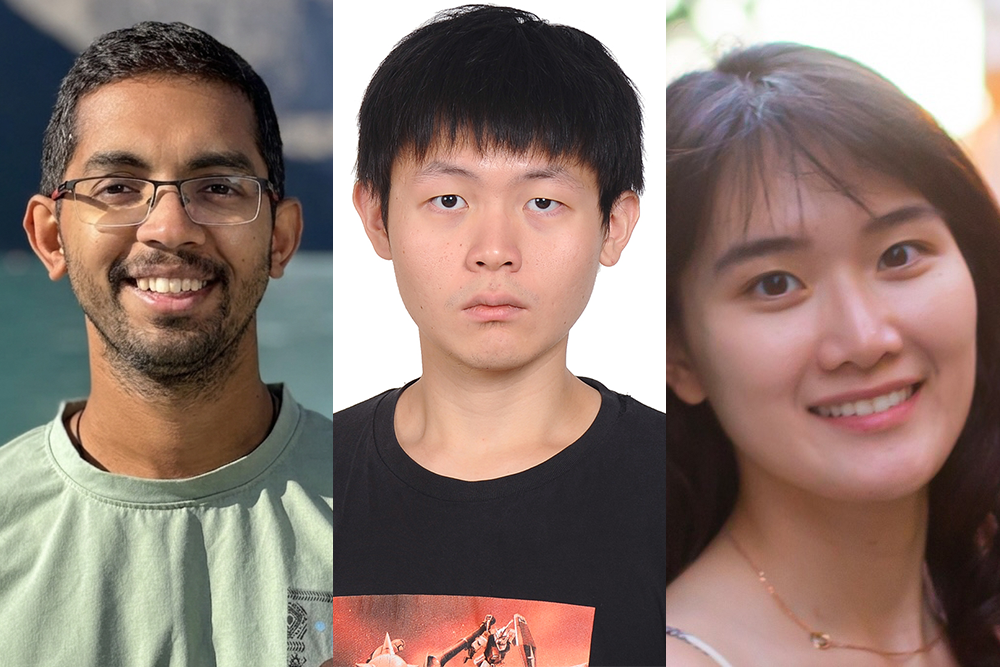
Despite pursuing varied careers in quantum machine learning, reinforcement learning and artificial intelligence agents, and trustworthy and fair AI, respectively, Srinivasan Arunachalam, Zhang-Wei Hong PhD ’25, and Irene Ko PhD ’24 have consistently found ways to tackle problems defined by novelty and rigor, and translate them to systems with real constraints. Here, the MIT-IBM Computing Research Lab served as a conduit for research relationship building and the flow of their expertise to industry applications.
“Among all the industrial labs, I think MIT-IBM has way better academic collaboration policy and opportunity [than the others],” says Hong, an IBM research staff member with the MIT-IBM Computing Research Lab who began his PhD at MIT in 2020 in the Department of Electrical Engineering and Computer Science (EECS).
Hong has been captivated with reinforcement learning since discovering that DeepMind could play Atari and learn from raw screen pixels via feature engineering. During his graduate work with EECS Associate Professor Pulkit Agrawal, who is also a principal investigator with the lab, Hong sought to build on this: improving value function learning for reinforcement learning in video games, using “Montezuma’s Revenge” in Atari, in order to predict and optimize the policy performance of an agent.
Source link