It’s been a tumultuous year for math. Big open questions that have occupied mathematicians for decades are now being solved in a matter of hours by artificial intelligence agents that companies deploy by the thousands to work on a single problem in tireless lockstep.
AI’s relentless rise is raising existential questions for the field: How will the tools affect humans’ understanding of mathematical concepts? In the face of AI’s brute-force productivity, will mathematicians still have jobs? And what will all this mean for mathematics as an intellectual pursuit?
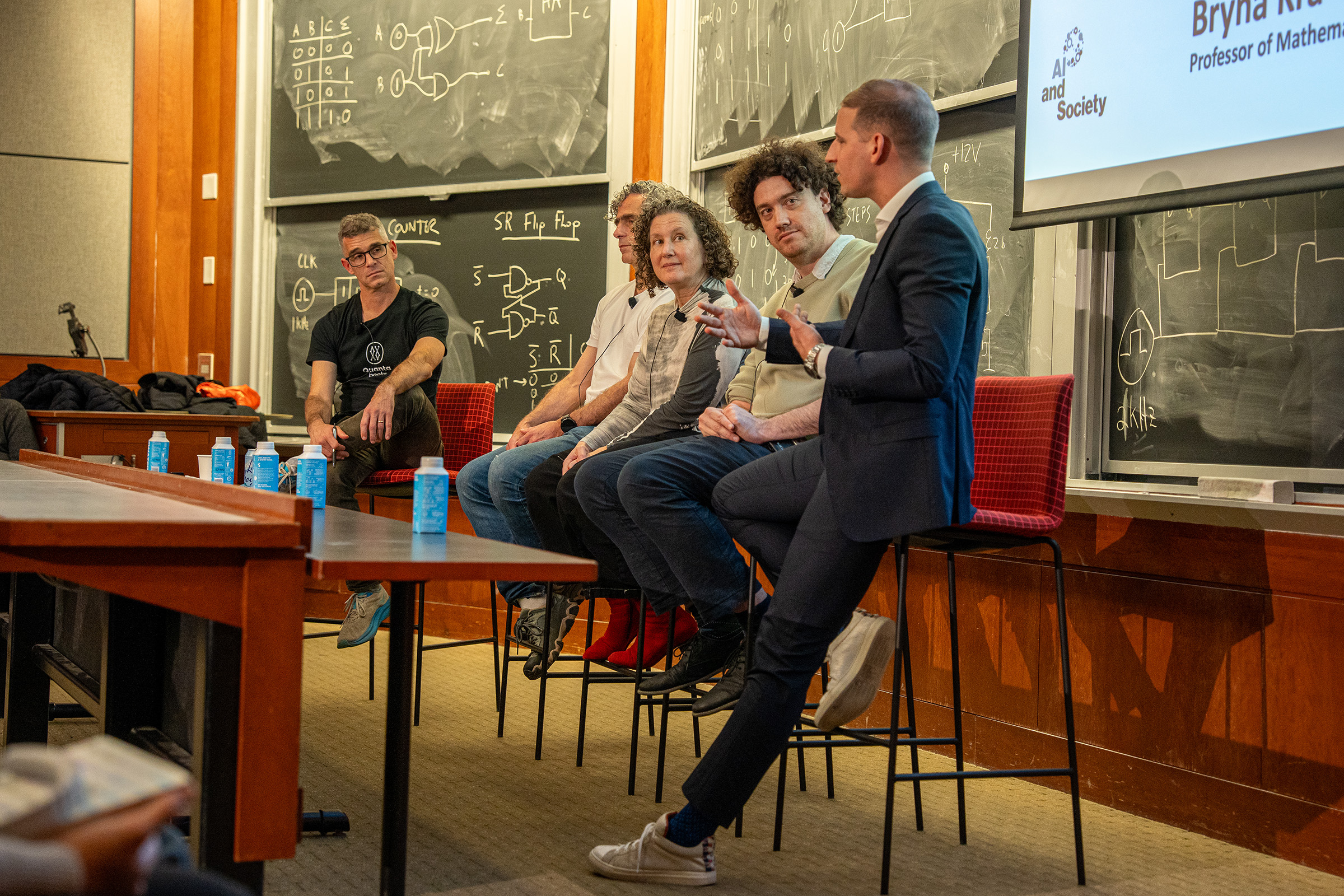
At MIT, mathematicians grappled with these and other questions at a panel discussion on Monday titled “AI and Society: The Future of Math.” Leading mathematicians from MIT, Harvard University, Northwestern University, and New York University — each experts in their respective fields — sat down for a conversation that touched on the quality of AI math, how AI is challenging long-established research norms, and the evolving opportunities for mathematicians, whether they embrace the machines or remain “AI vegans.”
The wide-ranging discussion, which took place in a packed lecture hall in MIT’s Building 3, was moderated by science writer Kevin Hartnett, author of “The Proof in the Code,” and featured Jacopo Borga, the Cecil and Ida Green Career Development Assistant Professor of Mathematics at MIT; Michael Hopkins, the George Putnam Professor of Pure and Applied Mathematics at Harvard University; Bryna Kra, the Sarah Rebecca Roland Professor of Mathematics at Northwestern University; and Tristan Buckmaster, professor of mathematics at New York University's Courant Institute of Mathematical Sciences.
Source link