This article has been reviewed according to Science X's editorial process and policies. Editors have highlighted the following attributes while ensuring the content's credibility:
A research team has developed a flexible near-infrared (NIR) photodetector that delivers photoresponsivity more than five times higher while maintaining its performance under repeated bending. The technology is expected to serve as a core platform for next-generation flexible optoelectronic devices, including wearable health care devices, medical diagnostic sensors and optical communication receivers.
Near-infrared light is invisible to the human eye but can penetrate skin and biological tissue relatively effectively. This property has enabled its widespread use in applications such as heart-rate and blood-oxygen monitoring in smartwatches, medical diagnostics, night imaging and optical communications.
Demand is also growing for flexible NIR sensors that can conform closely to the skin or curved surfaces. Most NIR sensors currently used in wearable devices, however, rely on rigid silicon photodetectors mounted on flexible substrates, limiting their suitability for applications involving repeated bending.
Flexible photodetectors based on organic semiconductors and quantum dots have been studied as alternatives, but organic semiconductors often suffer from insufficient durability, while quantum dots can exhibit limited environmental stability that leads to performance degradation.
To overcome these limitations, the Korea Institute of Materials Science (KIMS) research team led by Principal Researcher Jung-Dae Kwon, Yonghun Kim and Jongwon Yoon of the Energy & Environment Materials Research Division, developed a flexible NIR photodetector capable of maintaining high performance even under repeated mechanical deformation.
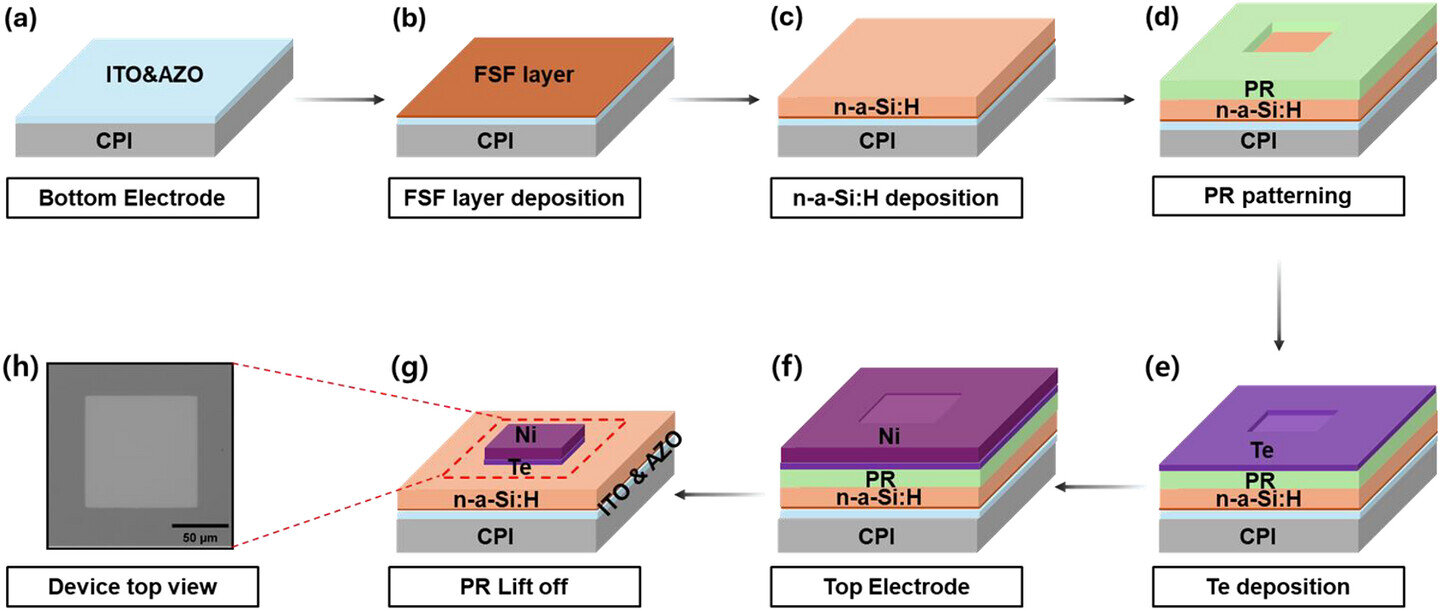
The device employs a heterojunction combining n-type hydrogenated amorphous silicon (n-a-Si), which is compatible with conventional CMOS semiconductor manufacturing processes, and tellurium (Te), which efficiently absorbs near-infrared light.
Source link