This article has been reviewed according to Science X's editorial process and policies. Editors have highlighted the following attributes while ensuring the content's credibility:
Many electronic devices use flame-retardant plastic as casing in order to reduce the risk of electrical fires. This plastic is formulated using a metal called antimony along with organic bromide compounds. In fact, 39% of the world's antimony is used to create flame-retardant plastics, most of which will eventually end up as part of the tens of millions of tons of electronic waste generated each year.
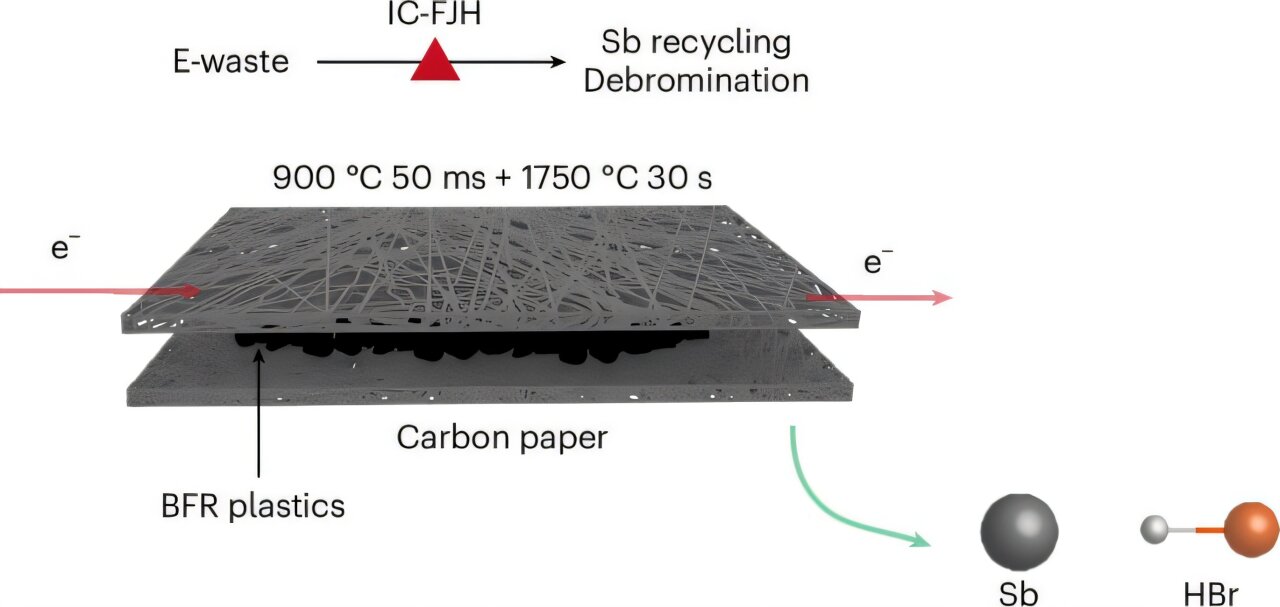
Rice University's James Tour has published a study in Nature Chemical Engineering detailing an improved method to recover antimony from this electronic waste stream.
"Antimony is a critical metal with a constrained supply," said Tour, the T.T. and W.F. Chao Professor of Chemistry and corresponding author on the study. "My research team has adapted our flash Joule heating technique to quickly and effectively recover antimony from this plastic waste stream."
To recapture antimony from the plastic, it first has to be released from the plastic. This is, chemically, a challenging step. As the antimony is released, other toxic compounds, organic bromides, can form that are difficult to capture.
"Conventionally heating the plastic releases the antimony in a volatile and difficult-to-collect form as well as creating and releasing hazardous organic bromide compounds," said Leo Haoxin Ye, the first author of this paper and a graduate student at Rice.
Source link