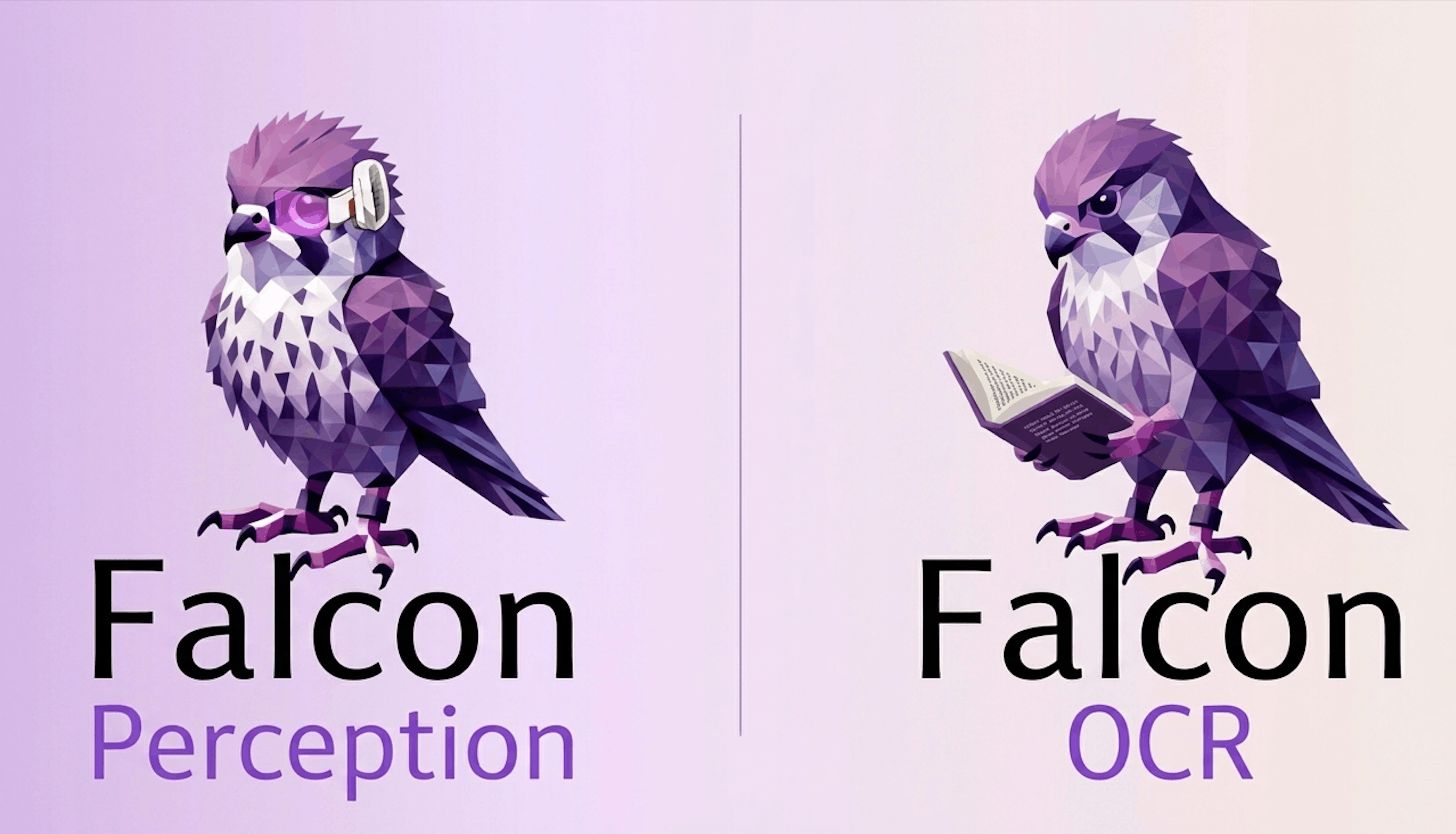
We also relase Falcon OCR, a 0.3B-parameter model which reaches a score of 80.3 and 88.6 on the olmOCR benchmark and OmniDocBench respectively, while having the highest throughput of any open source OCR model.
This post is a brief, practical write-up of what we built, why we built it this way, and what we learned along the way.
Many open-vocabulary perception systems are built as modular pipelines: a (often frozen) vision backbone extracts features, a separate fusion/decoder stage combines them with language, and additional components handle matching and post-processing. This family of designs works well in many settings, but it comes with trade-offs: it can be hard to scale cleanly, hard to attribute improvements to the right component, and easy to accumulate complexity as we add a new fix for each failure mode.
We asked a simpler question: can a single early-fusion Transformer backbone handle both perception and language modeling, if we choose the right attention pattern, output interface, and training signal?
In our experiments, the answer is largely yes. The rest of this post describes the main design choices and the evidence behind them.
A single autoregressive Transformer processes a unified sequence of image patches, text, and task tokens. The model predicts object properties in a fixed order: <coord> → <size> → <seg>. Bounding box coordinates and sizes are decoded via specialized heads and re-injected as Fourier features. High-resolution segmentation masks are generated by a dot product between the <seg> token and upsampled image features.
At its core, Falcon Perception is a dense Transformer that processes image patches and text tokens in a shared parameter space from the first layer .
Source link