
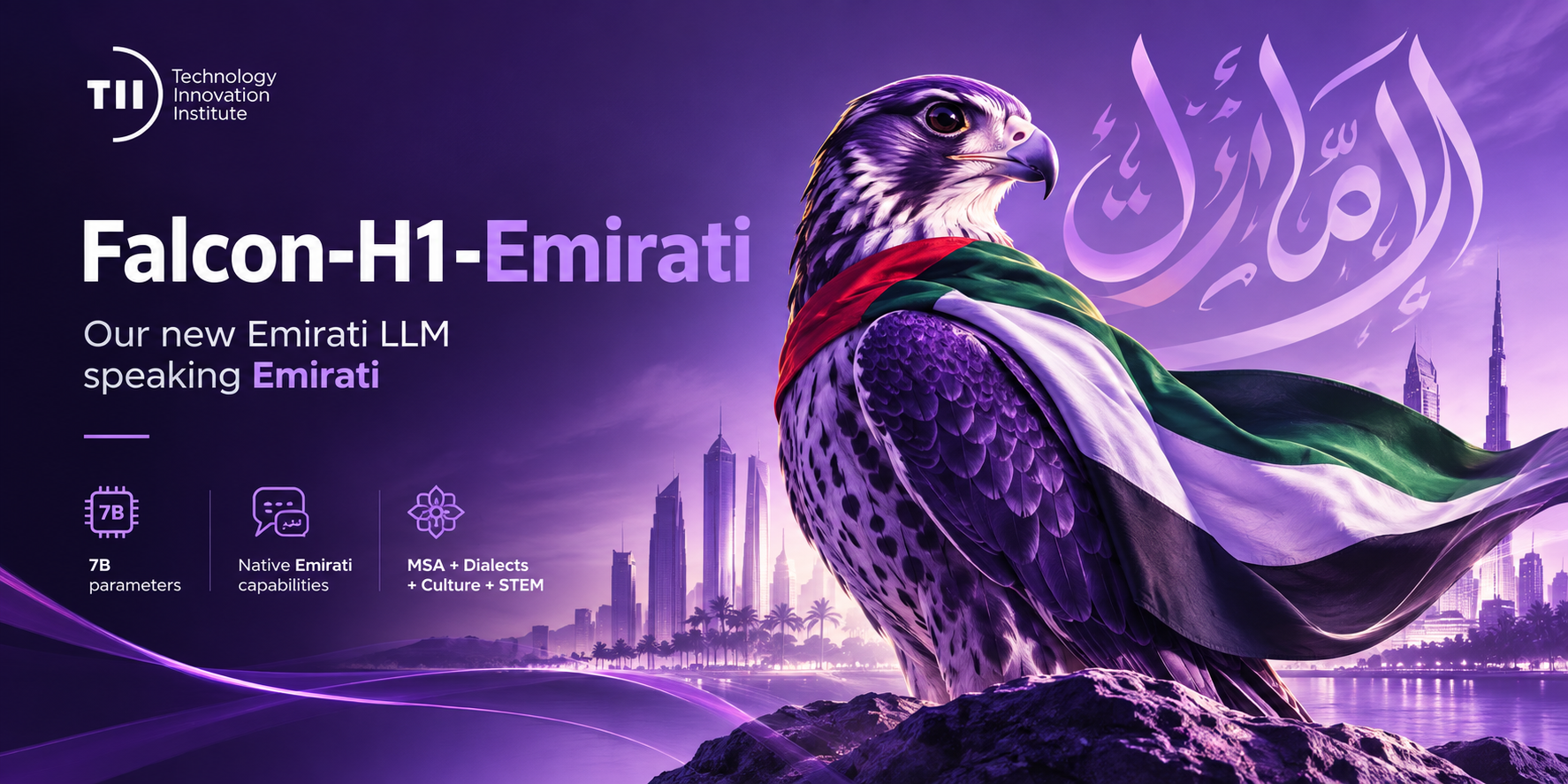
Arabic is really a family of languages living under one name. Modern Standard Arabic is what you read in the news or a textbook, but it's rarely how people actually talk to each other. In the UAE, day-to-day conversation, humor, negotiation, and storytelling happen in Emirati Arabic, a Gulf dialect with its own vocabulary, its own rhythm, and a culture wrapped tightly around it. Emirati poetry, especially nabati poetry, along with proverbs and short anecdotes, carries meaning that doesn't survive a literal, word-for-word reading. A model that only knows MSA can translate every word of an Emirati sentence and still miss what it actually means.
That's the gap Falcon-Emirati-7B is built to close. It's a dialect-specialized model on top of Falcon-H1-Arabic, aimed at understanding and generating Emirati Arabic the way a native speaker would: the vocabulary, the tone, and the cultural context behind it.
We didn't start from scratch. Falcon-Emirati-7B is built on Falcon-H1-Arabic, our Arabic model family that already set new benchmarks for the language earlier this year. Falcon-H1-Arabic uses the Falcon-H1 hybrid architecture: State Space Models (Mamba) and Transformer attention running in parallel inside every block, with their outputs fused before each block's projection. That combination gives the linear-time efficiency of Mamba on long sequences while keeping the precision of attention for long-range dependencies, which matters for a morphologically rich language like Arabic. The family spans three scales (3B, 7B, and 34B parameters) with context windows up to 128K and 256K tokens, and it was already trained on a broad mix of MSA and dialectal Arabic (Gulf, Levantine, Egyptian, Maghrebi) alongside English and multilingual data.
Source link





