This article has been reviewed according to Science X's editorial process and policies. Editors have highlighted the following attributes while ensuring the content's credibility:
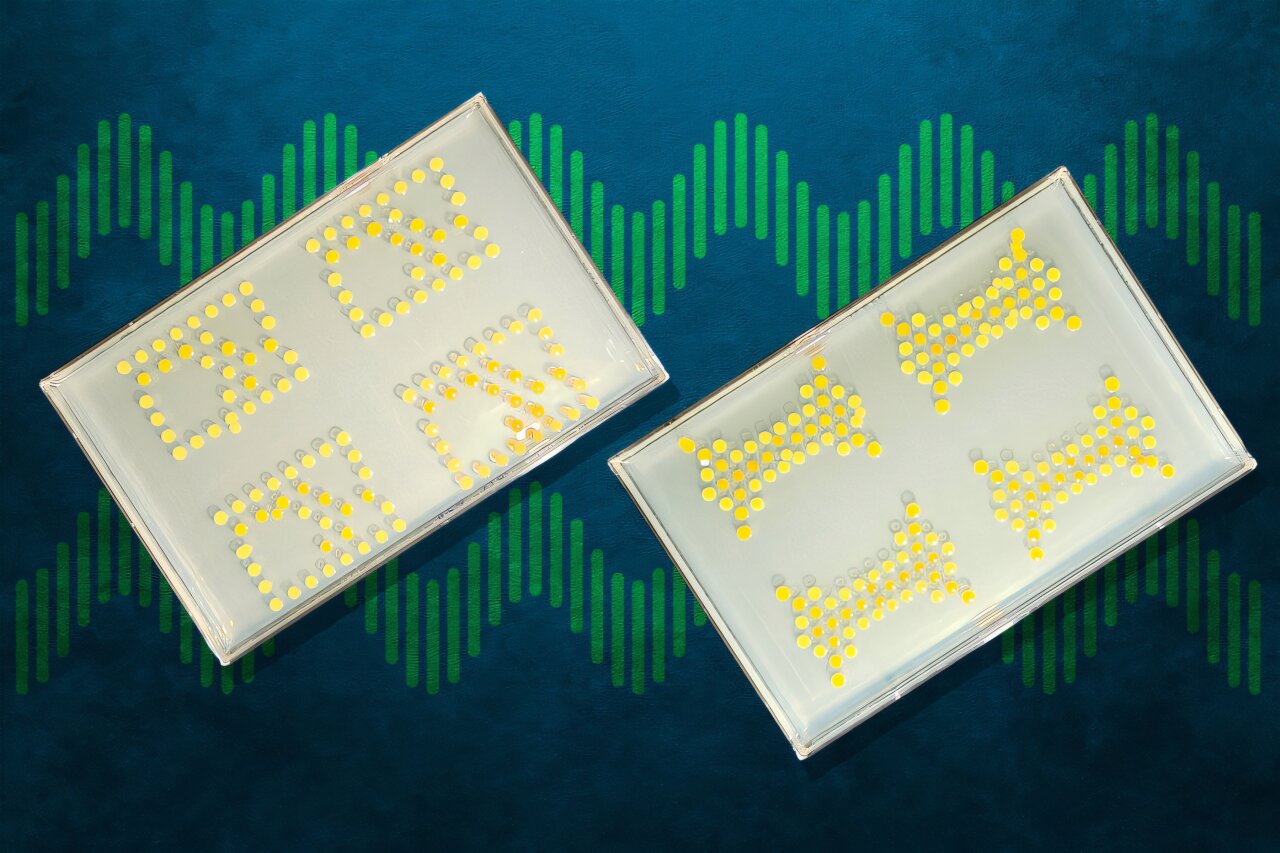
MIT researchers have engineered bacteria that can function as transistors, allowing the team to create living "circuit boards" that can be printed onto a growth medium in a Petri dish.
In electrical circuits, transistors function as switches that can turn current on or off. In the biological circuits that the researchers have created, bacterial switches control the flow of small molecules, which send signals to downstream circuit components.
The research team designed two different transistors, along with three bacterial strains that relay information between the transistors, giving them the building blocks they need to design nearly any type of circuit. In a new study, they used these cells to create circuits that can add two or three inputs, or send one input to a specific location in the circuit.
"We've built some initial computer architecture components that are commonly used, but any operation can be built with these five strains," says Hamid Doosthosseini, Ph.D. '25, an MIT postdoc and the lead author of the new study.
Using this approach, the researchers hope to develop circuits that one day could coat plant leaves or roots, where they could compute to sense and respond to environmental conditions such as drought or attack by pests.
Christopher Voigt, head of MIT's Department of Biological Engineering, is the senior author of the paper, which was recently published in Nature Chemical Biology .
Source link