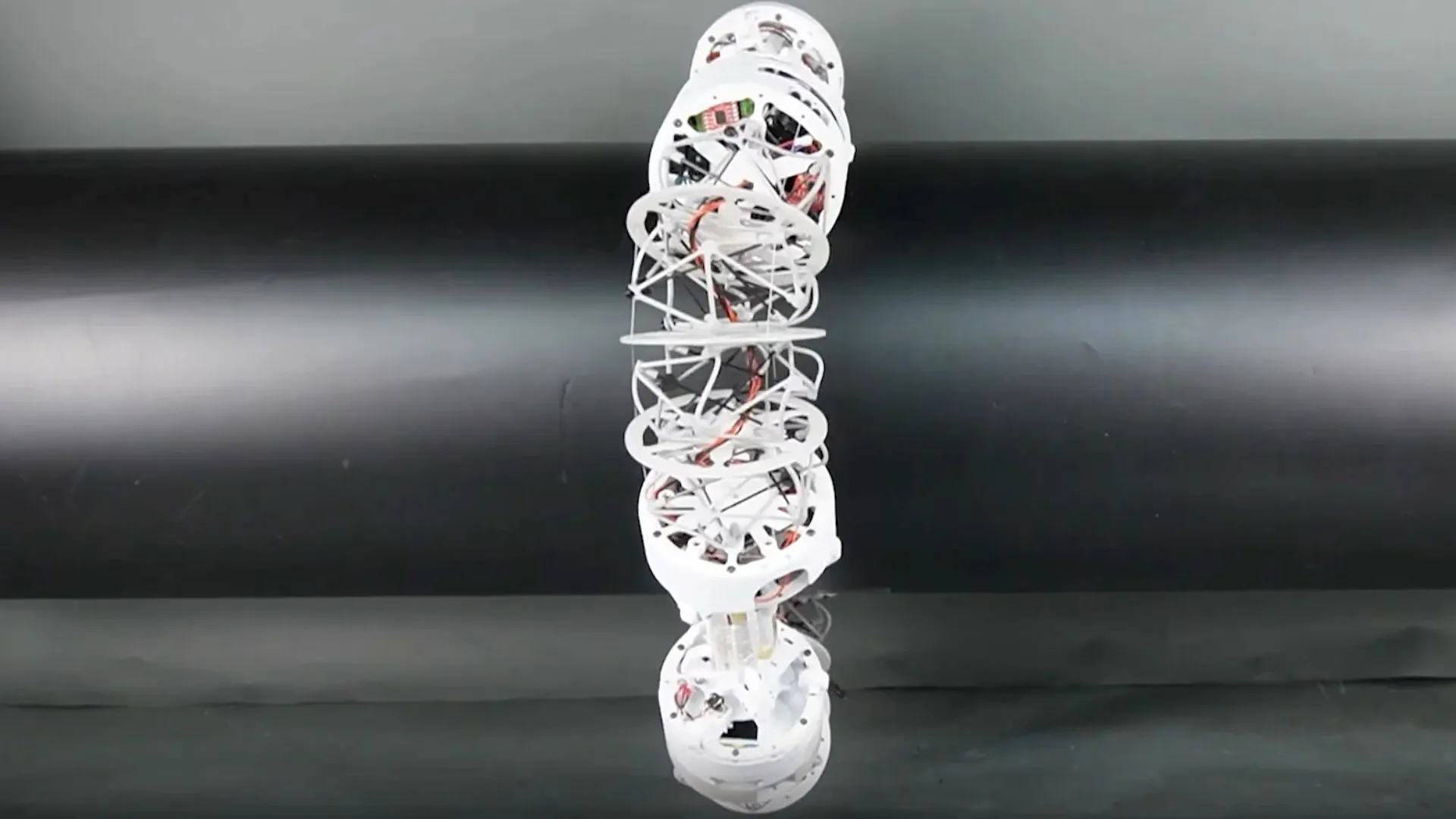
Researchers at Colorado State University have developed flexible robots inspired by elephant trunks that can bend, grip objects, and connect with other machines. The robots use a structural design called tensegrity, in which rigid rods are held together by tensioned cables rather than fixed joints.
The construction allows them to collapse, bend, and change shape while using gripping claws at both ends of their tube-like bodies to manipulate objects or attach to other robots.
The technology could eventually enable teams of robots to support space exploration and other complex tasks.
The system combines a flexible body with mechanical claws, allowing individual robots to operate independently or assemble into larger configurations.
The technology addresses a limitation in existing modular robots, which typically use rigid components that restrict their ability to adapt to different environments and tasks. The researchers aim to combine the flexibility of soft robots with the reconfigurability of modular robotic systems.
The new machines use a structural design called tensegrity, in which rigid rods are held together by a network of tensioned cables rather than being permanently fixed to one another. This arrangement allows the robot’s body to bend, stretch, collapse, and change shape while maintaining its structural integrity.
Unlike conventional robotic arms, which rely on fixed joints to control movement, the tube-like machines have flexible bodies that can deform continuously. They also feature mechanical gripping claws at both ends, allowing them to grasp objects and connect with other robots.
Source link