This article has been reviewed according to Science X's editorial process and policies. Editors have highlighted the following attributes while ensuring the content's credibility:
As electronic devices become smaller and more powerful, keeping them from overheating is an increasingly difficult engineering challenge. Now, Cornell researchers have developed a computational method, backed by the first experimental measurements of their kind, showing how an electric field can change the way a semiconductor conducts heat.
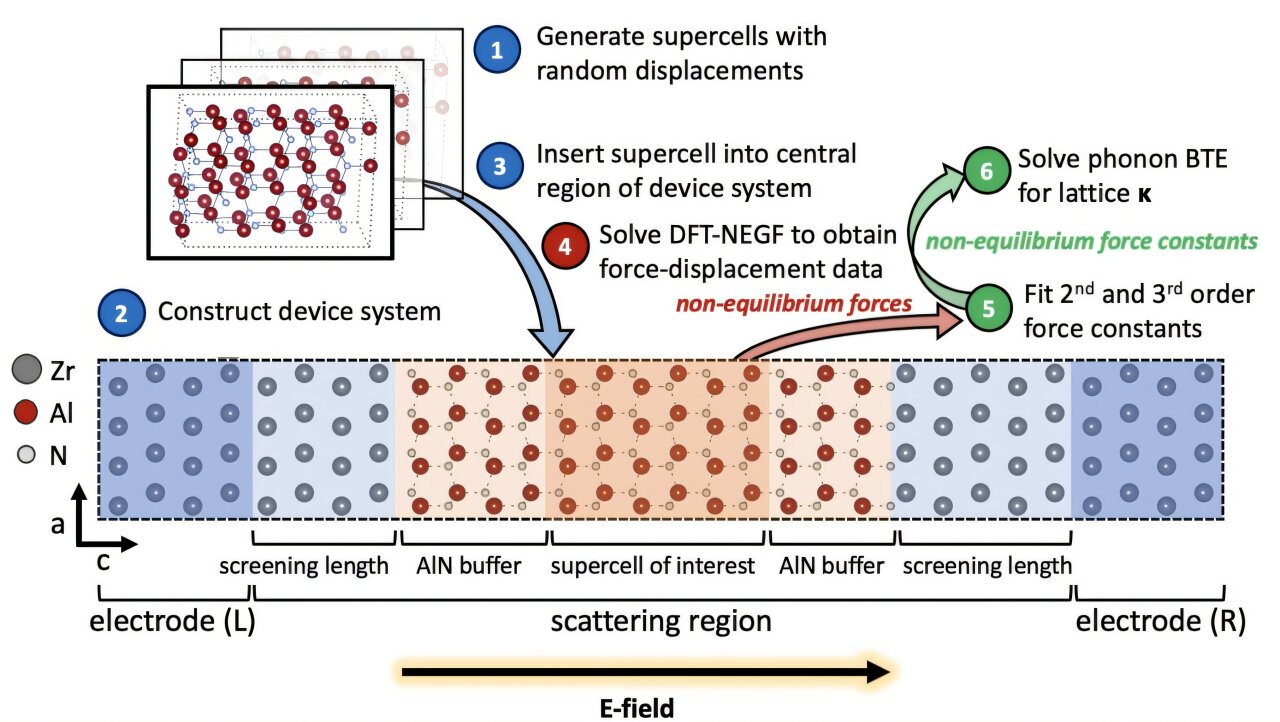
The research, led by Zhiting Tian, the John Brancaccio Professor in the Sibley School of Mechanical and Aerospace Engineering, predicts that the cross-plane thermal conductivity of aluminum nitride, a promising material for next-generation electronics, can either increase or decrease depending on the direction of an applied electric field.
The findings, described in the paper "Thermal conductivity of wurtzite aluminum nitride under external electric field," published in npj Computational Materials, suggest that engineers could eventually design electronic components that dissipate heat more effectively under an operating electric field by aligning the field direction favorably with the crystal polarity.
"When we think about the thermal conductivity of a material, the way we usually model it is without an applied electric field," Tian said. "But in real device operations, especially for those of high power density devices, the electric field is actually significant."
The Cornell team focused on aluminum nitride, an ultrawide-bandgap semiconductor capable of withstanding substantially higher electric fields than conventional semiconductor materials. Such materials could enable smaller, more powerful electronics, including high-voltage power systems and high-power radio-frequency devices.
Source link