
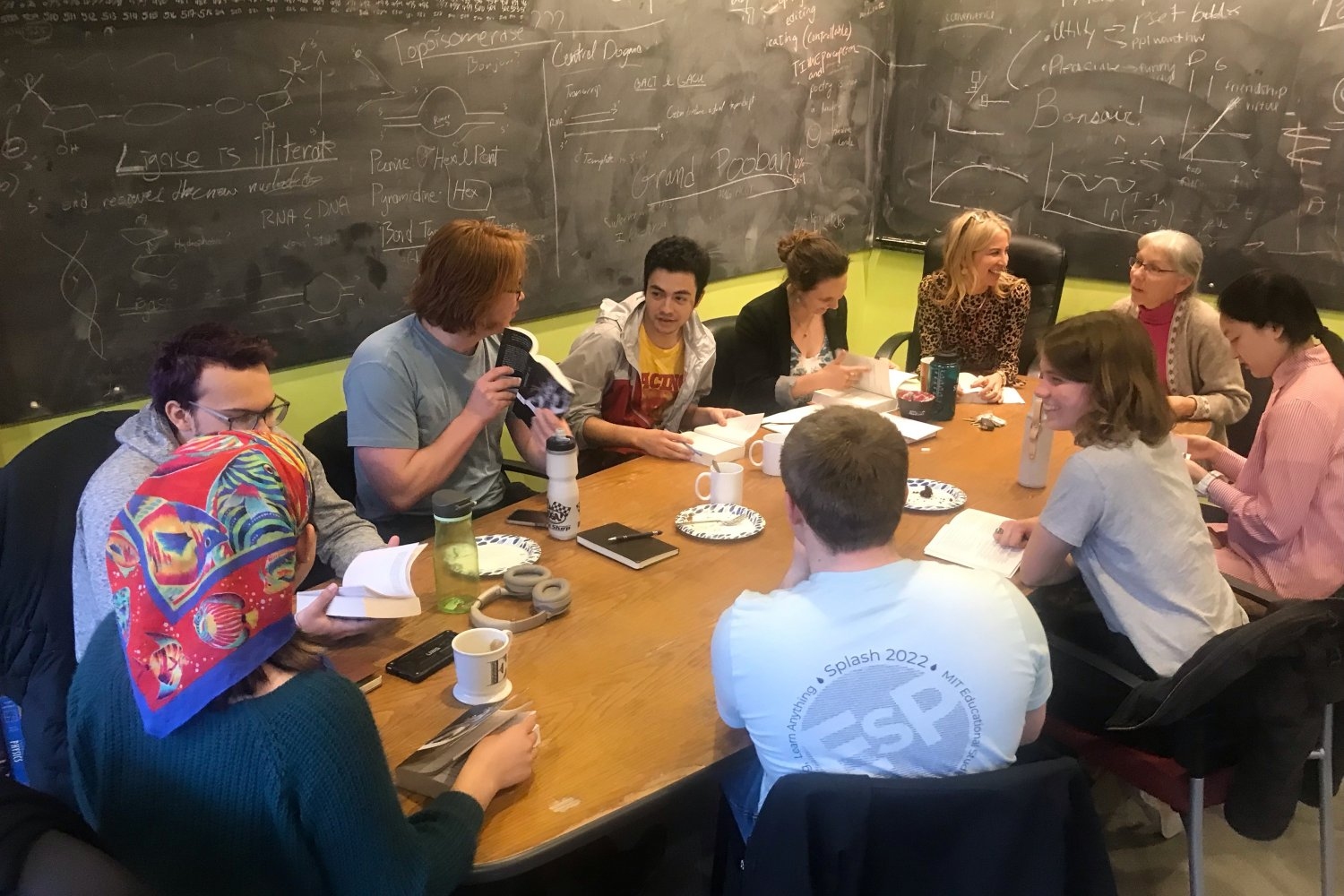
Artificial intelligence has become part of the zeitgeist. And while it’s a polarizing topic, Linda Rabieh has a unique take on AI: “It’s good for business. Our business, of humanistic thinking.” As senior lecturer in the Concourse program, one of MIT’s first-year learning communities, Rabieh has been introducing students to the “business” since 2010.
“What AI has been useful for is making very vivid to students today the question of what it means to be human,” she adds. “They’re meeting this question with a new urgency. What is intelligence? Is it only mathematical intelligence? Is it only an aggregation of information? Or is human intelligence something different?”
AI is just one of countless thorny topics that bubble up in Concourse, which offers first-year MIT students a foundation in the humanities, alongside math and science General Institute Requirement courses taught by Concourse faculty. Studying “great books” and literary luminaries — Plato, Homer, Aristotle, Wordsworth and Coleridge, to name a few — provides a springboard for rich conversations and spirited debates.
Concourse was founded in 1970 to enable humanities, engineering, and science faculty to collaborate on curriculum, cultivating a “concourse” of ideas. Now it’s a place, Rabieh says, “where students who come primarily to MIT for world-class science, math, and engineering can also have a traditional liberal education, exploring fundamental questions of human existence, reading the great books, engaging in intense, vigorous debate about these questions.”
“I often describe Concourse as a mini-liberal arts college within MIT,” says Assistant Director Sasha Rickard ’19, an alumna of the program.
Source link





