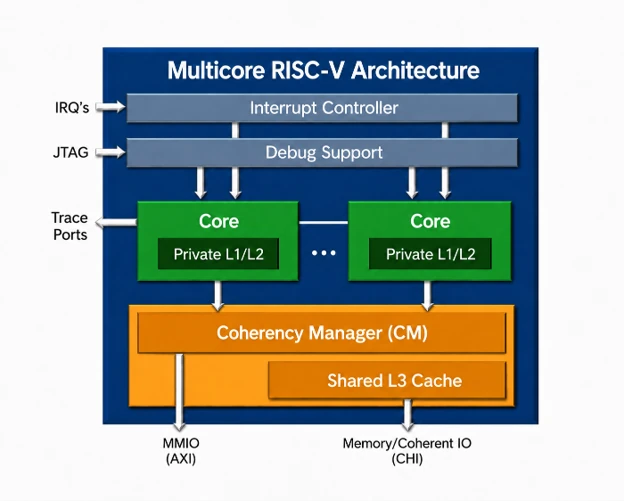
Data center and high-performance computing workloads are pushing CPU designers to deliver higher per-watt throughput and support complex multicore systems. Meeting these goals requires specialized compute cores. This reality is forcing engineers to rethink not only how cores are built, but also which instruction set architecture (ISA) can scale efficiently, support software validation, and still create product differentiation. To meet these challenges, a lean R&D team from a startup company in Austin, Texas, chose the RISC-V ISA as the foundation for its first CPU IP microarchitecture.
Designing the microarchitecture involved balancing software-visible architectural behavior, RTL implementation details, and internal performance and power tradeoffs, which together introduced verification requirements that extended well beyond isolated hardware blocks. When these interactions are not addressed early in development, system-level issues can emerge later, making them more difficult to resolve. These decisions also expanded the scope of verification. The core had to be validated with actual software under full-system scale, including interactions that extend beyond individual hardware blocks.
To manage the complexity, the engineers adopted a formal-first verification strategy. By applying formal analysis during the design cycle, key architectural properties were proven before transitioning to large-scale simulation and system bring-up. Formal verification handled block-level functionality and end-to-end checks of functional intent. Simulation and emulation addressed long-running behavior in the full-core environment. Some failures may not emerge until the design has run for tens of millions of cycles under full operating system (OS) stress.
The design and verification group used a tightly integrated Cadence tool flow spanning architectural proof, software-driven verification, simulation, emulation, and cloud-based compute infrastructure.
Source link