DeepMath is an aligned math reasoning agent built on Qwen3-4B Thinking and fine-tuned with GRPO (Group Relative Policy Optimization). Instead of verbose text, the model emits tiny Python snippets for intermediate steps, runs them in a secure sandbox, and folds the results back into its reasoning, reducing errors and output length. The agent is implemented using the smolagents library.
We evaluate DeepMath on four math datasets: MATH500, AIME, HMMT, and HLE, and show that:
🤖 The math agent alone reduces output lengths by up to 66%, while often improving accuracy.
⚡ GRPO training improves the agent performance even further, in almost all benchmarks.
Large language models (LLMs) have advanced reasoning capabilities, but mathematical problem-solving remains challenging; chain-of-thought traces can be lengthy and prone to arithmetic mistakes. Recent works[^1][^2] demonstrate that small models can reach strong performance, and other studies[^3] investigate tool use to improve reliability. What those papers generally do not emphasize is reducing trace verbosity or explicitly training models to prefer short, computation-oriented traces executed in a constrained, auditable environment.
DeepMath tackles this by combining a small Python executor with a fine-tuned LLM, enabling concise, computation-driven reasoning. The model learns to generate short Python snippets, which are executed in a sandbox and reintegrated into the context. GRPO fine-tuning encourages this behavior by rewarding correctness and encouraging shorter outputs.
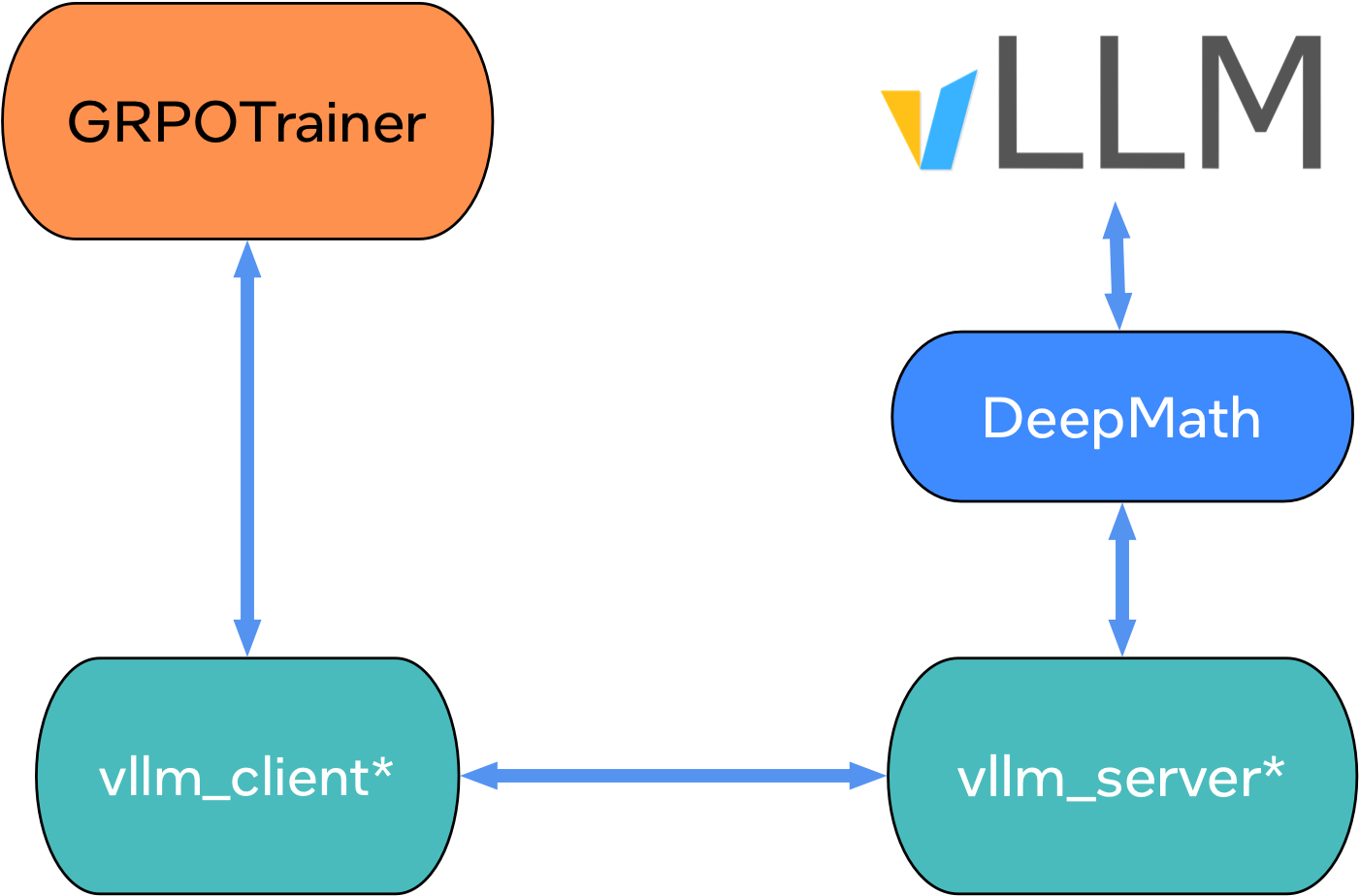
Figure 1: The vLLM client and server were modified to use the DeepMath agent in generating the candidates, while using the vLLM backend.
Agent Interface: During inference, the model can output normal tokens or special agent calls containing Python snippets.
Source link