
This article has been reviewed according to Science X's editorial process and policies. Editors have highlighted the following attributes while ensuring the content's credibility:
Silicon-based microelectronics have powered the digital revolution, but their performance and efficiency are starting to reach limits imposed by the fundamental properties of silicon itself.
One candidate for continuing the trend of increasing computing power is "two-dimensional" materials: Just one atom thick, they can maintain excellent electronic performance even past the point when silicon begins to encounter significant scaling challenges. However, the structural feature that gives 2D materials this advantage also makes it more difficult to fabricate them into practical devices.
Qing Cao, a materials science and engineering professor at the University of Illinois Urbana-Champaign's Grainger College of Engineering, has found a surprising solution in nanoparticles made from coal.
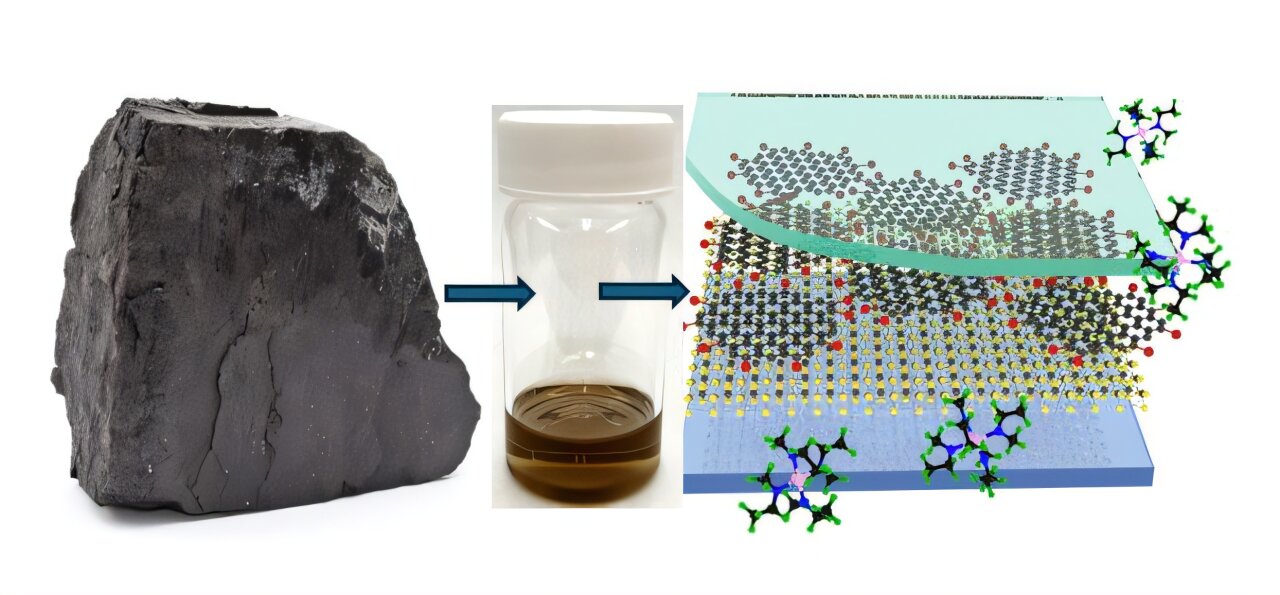
Working with the U.S. Department of Energy's National Energy Technology Laboratory (NETL), Cao has identified carbon nanodots—graphene-like particles 1 to 5 nanometers wide and one atomic layer thick—derived from bituminous coal as an atomic-scale interfacial binder.
They facilitate integration with 2D materials such as graphene and molybdenum disulfide without hybridizing with the 2D channels, providing a clean interface and supporting growth of ultrathin, thermally stable dielectrics.
"Devices made from 2D materials are very attractive because they can continue scaling to dimensions where silicon begins to encounter significant performance challenges," Cao said.
"But without a 3D chemical structure, it is very difficult to directly grow the insulating dielectric layers on top required for transistor operation.
Source link





