Introducing a collaborative AI partner for researchers to develop new hypotheses in life sciences and beyond.
Every great scientific breakthrough begins with a single, transformative idea. The spark of discovery relies on a researcher's ability to connect disparate facts and formulate the right hypothesis to test. But in an era of information overload and increasingly complex challenges, the search for these needle-in-a-haystack ideas has become a significant bottleneck for progress.
We believe AI can help dramatically accelerate the pace of breakthroughs by serving as a dedicated partner in the generation and refinement of breakthrough scientific hypotheses.
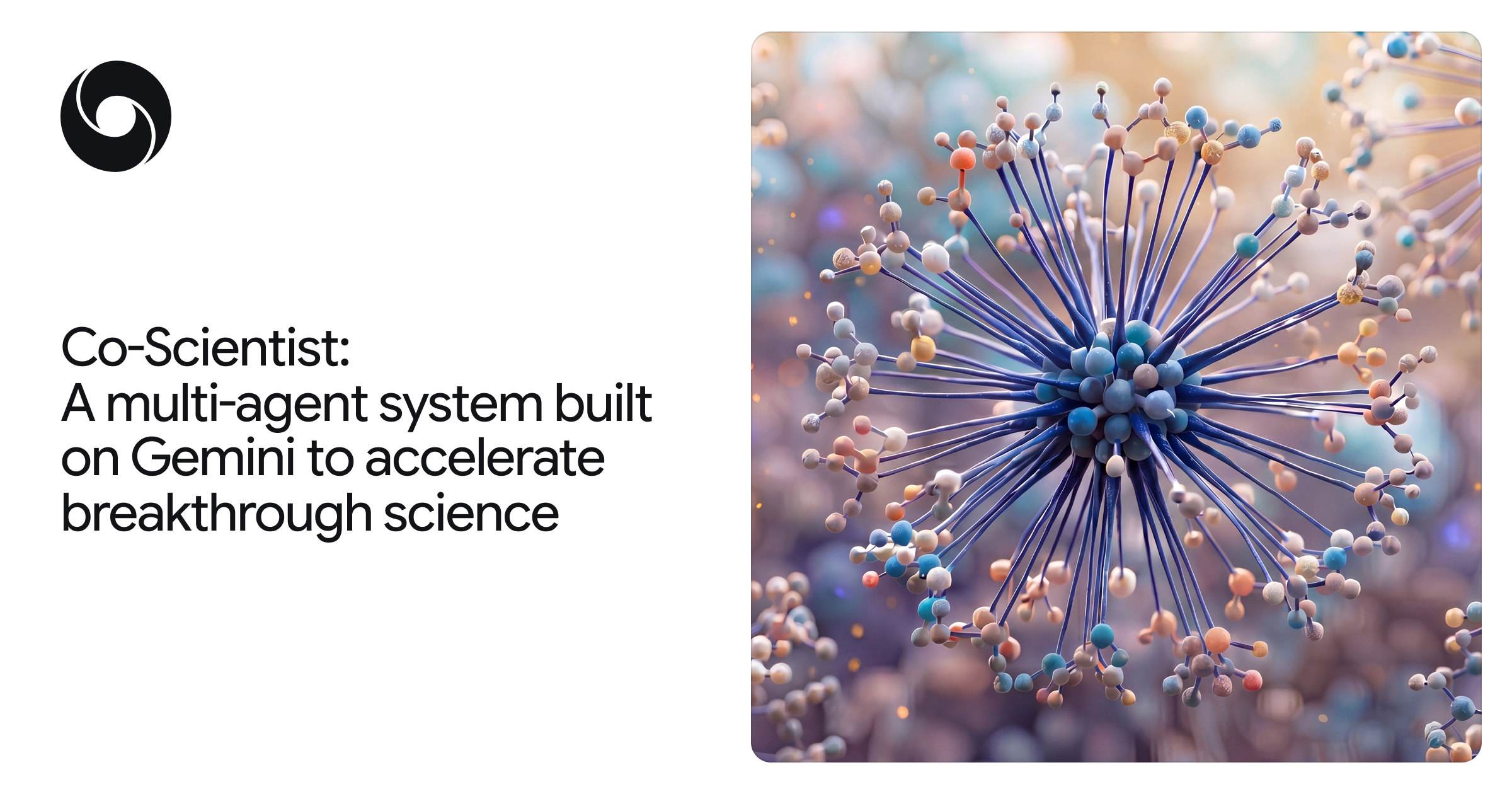
Today, in Nature we published our latest Co-Scientist research, introducing a new multi-agent AI system built with Gemini that iteratively generates, debates, and evolves novel hypotheses for complex scientific problems.
We are making the Co-Scientist system available to individual researchers through Hypothesis Generation, a new experimental tool jointly developed across Google DeepMind, Google Research, Google Cloud and Google Labs. We’ll begin rolling out in the coming weeks and researchers can register their interest at labs.google/science.
Since sharing our early research last year, we’ve been developing and testing Co-Scientist together with teams who are leveraging it to tackle challenging problems - from antimicrobial resistance and plant immunity to liver fibrosis. We’re excited to share some of the ways it is already being applied across fundamental biology, the natural sciences, and engineering.
Scientific discovery is rarely a straight line; it is a cycle of ideation and hypothesis generation, critique, and refinement. Scientists often reach their most profound insights only after wrestling with a complex problem for days, months, or even years.
Source link