Business News Tech AI China's Hesai launches spatial camera to boost AI-powered robotics adoption
The company introduced "Kosmo," a device resembling a wine bottle, that combines lidar sensors and cameras to help developers collect real-world spatial data more efficiently.
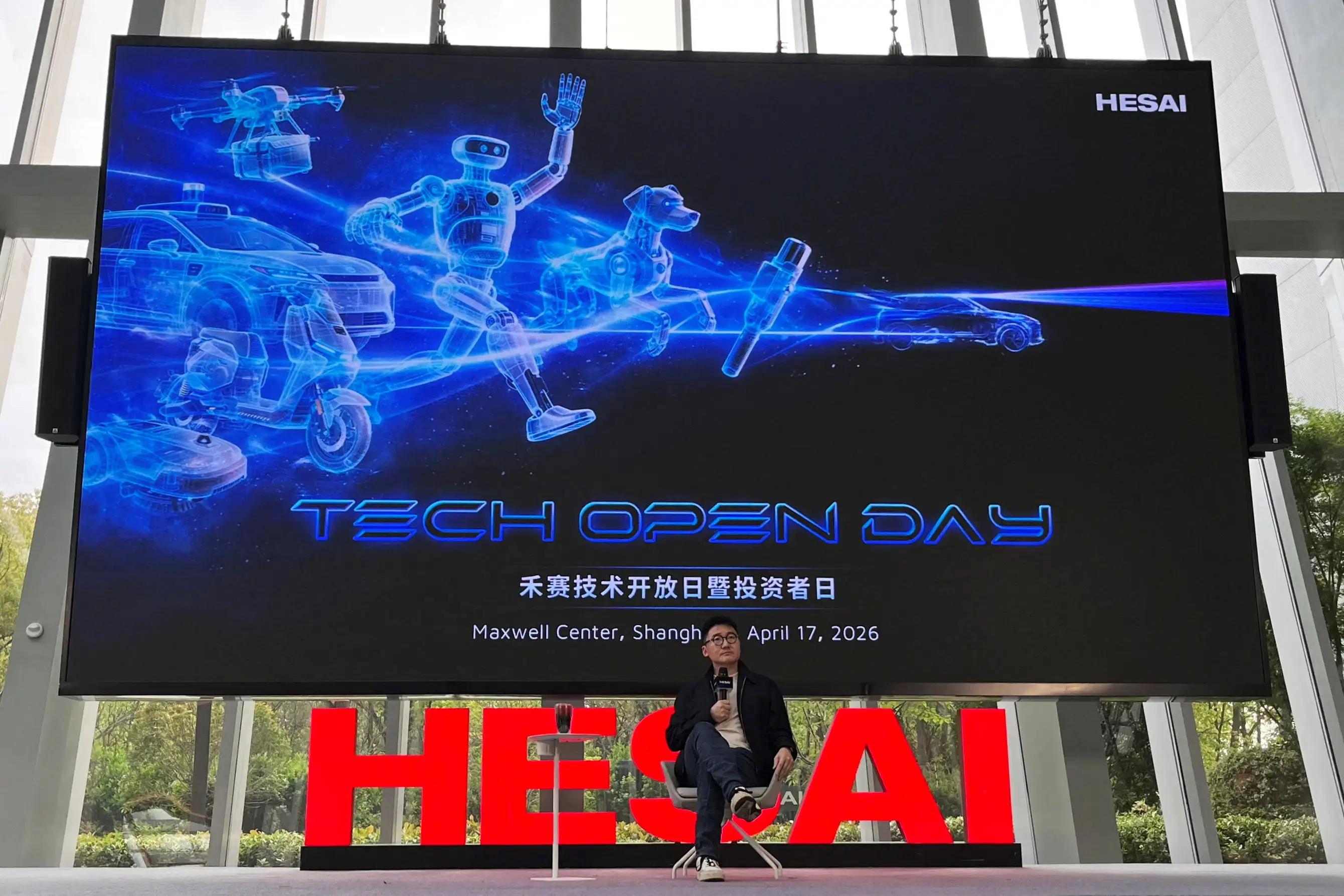
Hesai Group , a leading Chinese autonomous driving technology firm, on Wednesday unveiled a three-dimensional mapping camera, targeting demand for physical spatial data needed to train the AI systems powering humanoid robots. The company introduced " Kosmo ," a device resembling a wine bottle, that combines lidar sensors and cameras to help developers collect real-world spatial data more efficiently. There is a significant gap in high-quality spatial data needed to train AI-powered robots to understand and interact with the real world and perform complex tasks beyond waving arms or dancing, Hesai co-founder and CEO David Li said at a launch event at the company's Shanghai factory.
Li said robots remain limited in their ability to solve real productivity challenges. Most robots are still confined to low-impact functions like greeting guests, waving or dancing, he said. "What we aim to offer is essentially a platform for the underlying technologies required by the robotics industry, positioning Hesai as a tier 1 supplier comparable to Bosch in the automotive sector, or perhaps even beyond," Li said. He declined to provide revenue projections for Kosmo but said the firm has signed agreements with Chinese robotics firms to use the product. Hesai has also been developing robot actuators, which convert electricity into mechanical motion and account for more than half of a robot's material costs, Li said.
Source link