Taken together, these scaling regimes push the foundation-model lifecycle—pre-training, post-training, and inference—toward convergent infrastructure requirements: tightly coupled accelerator compute, a high-bandwidth low-latency network, and a distributed storage backend. They also raise the importance of orchestration for resource management, and of application- and hardware-level observability to maintain cluster health and diagnose performance pathologies at scale.
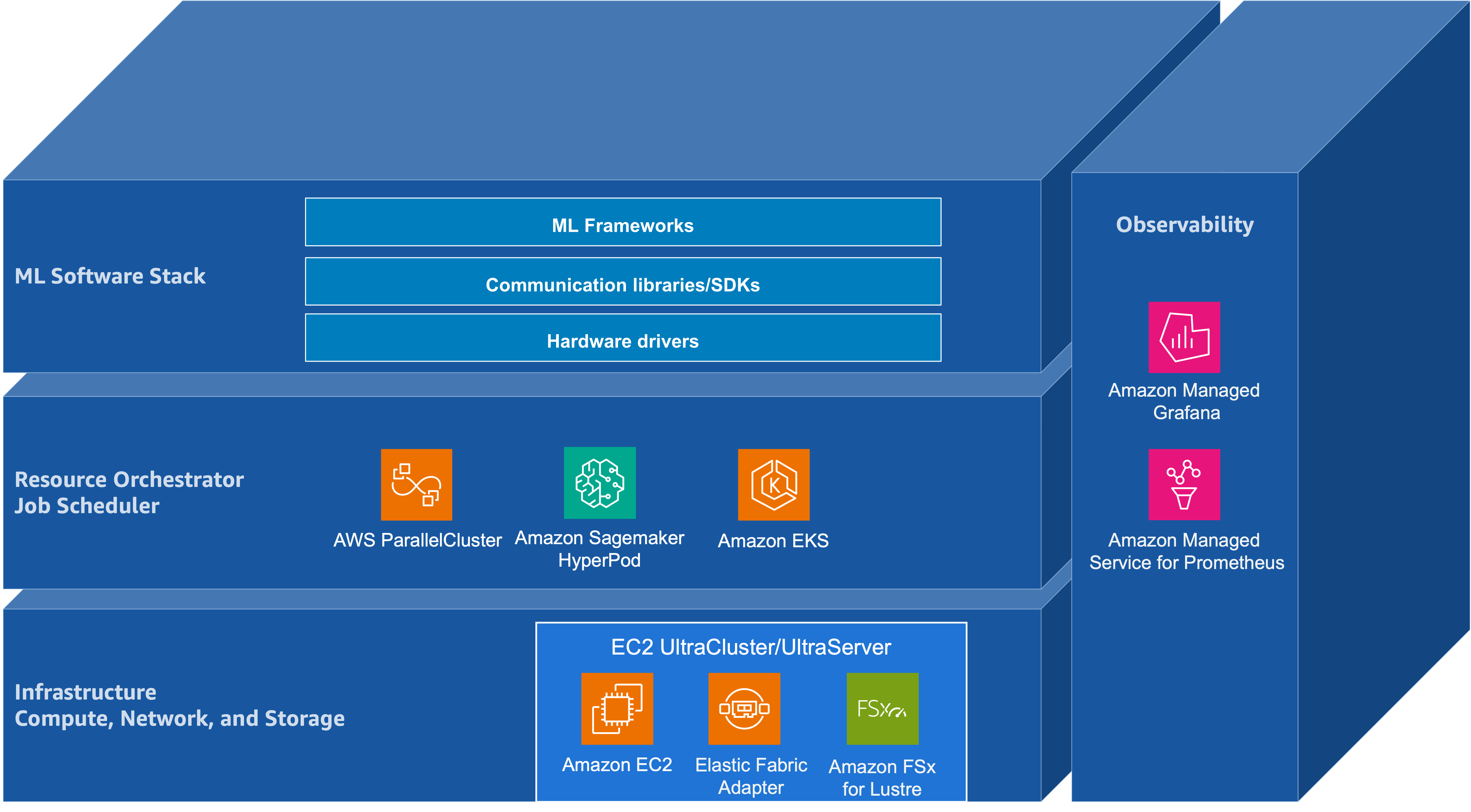
Another key trend is the increasing reliance of the foundation-model lifecycle on an open-source software (OSS) ecosystem that spans model development frameworks, cluster resource management, and operational tooling. At the cluster layer, resource management is typically provided by systems such as Slurm and Kubernetes. Model development and distributed training are commonly implemented in frameworks such as PyTorch and JAX. Monitoring and visualization—that is, observability—are often achieved using Prometheus for metrics collection and Grafana for visualization and alerting, positioned as an operational layer atop infrastructure and resource management. Figure 1 illustrates this layered architecture, showing how hardware infrastructure supports resource orchestration, which in turn enables ML frameworks, with observability spanning across all layers.
Figure 1: The layered architecture of open-source software stacks for foundation model training and inference
This post is intended for machine learning engineers and researchers involved in foundation model training and inference, with particular attention to workflows built atop OSS frameworks. It analyzes how AWS infrastructure—including multi-node accelerator compute, high-bandwidth low-latency networking, distributed shared storage, and associated managed services—interacts with common OSS stacks across the foundation model lifecycle. The primary goal is to provide a technical foundation for understanding systems bottlenecks and scaling characteristics spanning pre-training, post-training, and inference.
Source link