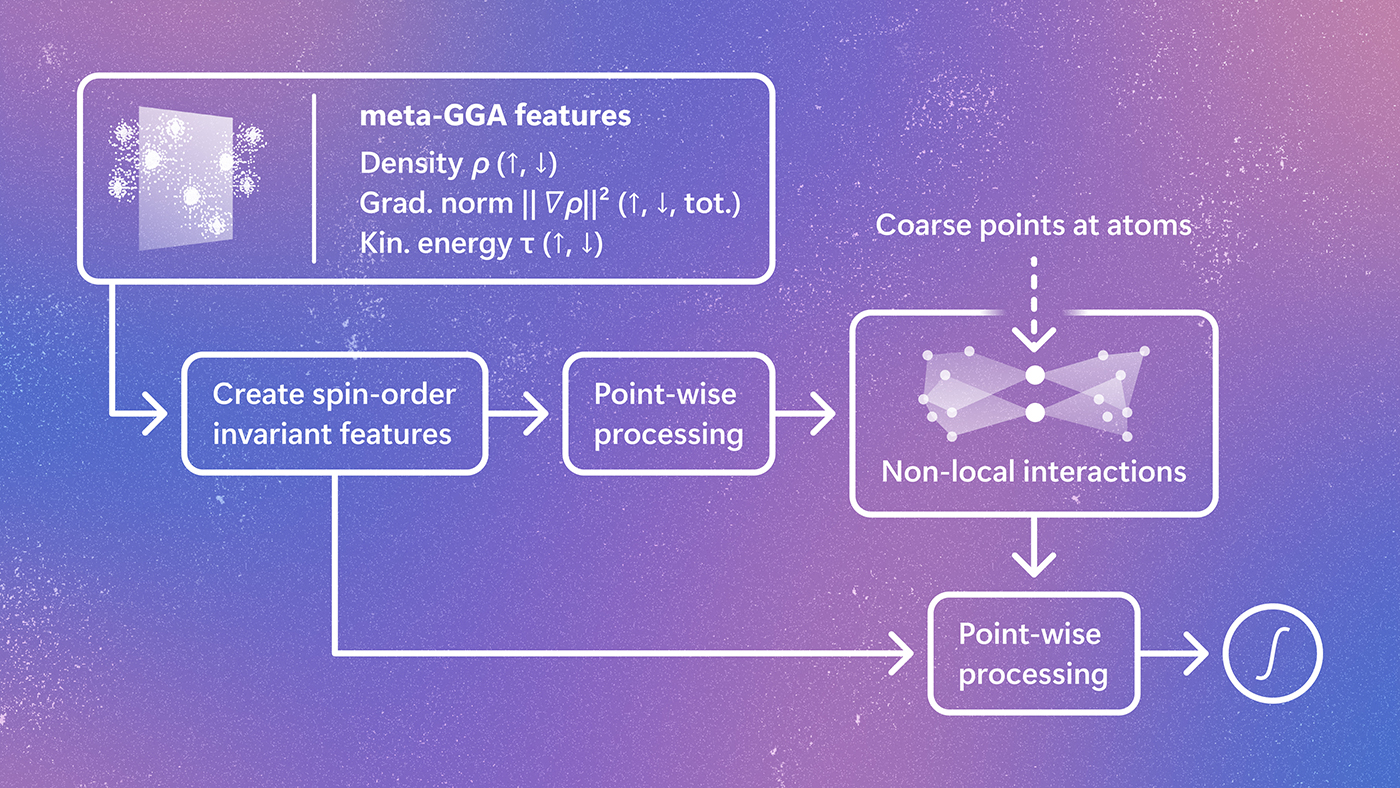
Bringing density functional theory (DFT) to predictive accuracy is a journey, not a single breakthrough. Since introducing Skala, our deep-learning exchange-correlation functional, we have continued to advance along two complementary fronts: improving accuracy and expanding accessibility across the computational chemistry ecosystem.
On the accuracy front, the release of Skala-1.1 (opens in new tab) provides the first demonstration of the continuous-improvement paradigm underlying Skala. Trained on 2.5x more data than the first public version of Skala, the updated model delivers substantially improved performance across key challenges in molecular simulation, including main-group thermochemistry, reaction kinetics, and molecular structure prediction.
But accuracy alone is not enough. DFT is the computational engine behind a vast range of scientific and industrial workflows, spanning chemistry, materials science, catalysis, energy technologies, and drug discovery. To have real-world impact, advanced functionals must be accessible where scientists already perform their calculations. That is why we are also expanding the Skala ecosystem through collaborations with leading electronic-structure software developers.
Today, we are announcing that Skala is available in CP2K and is being integrated into Psi4 , FHI-aims , ORCA and VASP , bringing next-generation DFT accuracy closer to the communities that rely on these codes every day. Alongside these integration efforts, we are introducing a living benchmark that tracks the computational performance of successive, increasingly optimized Skala releases. By providing a transparent and continuously updated reference for implementations across software packages and hardware platforms, this resource will help the community measure and accelerate progress toward ever greater accuracy and efficiency.
Source link