This article has been reviewed according to Science X's editorial process and policies. Editors have highlighted the following attributes while ensuring the content's credibility:
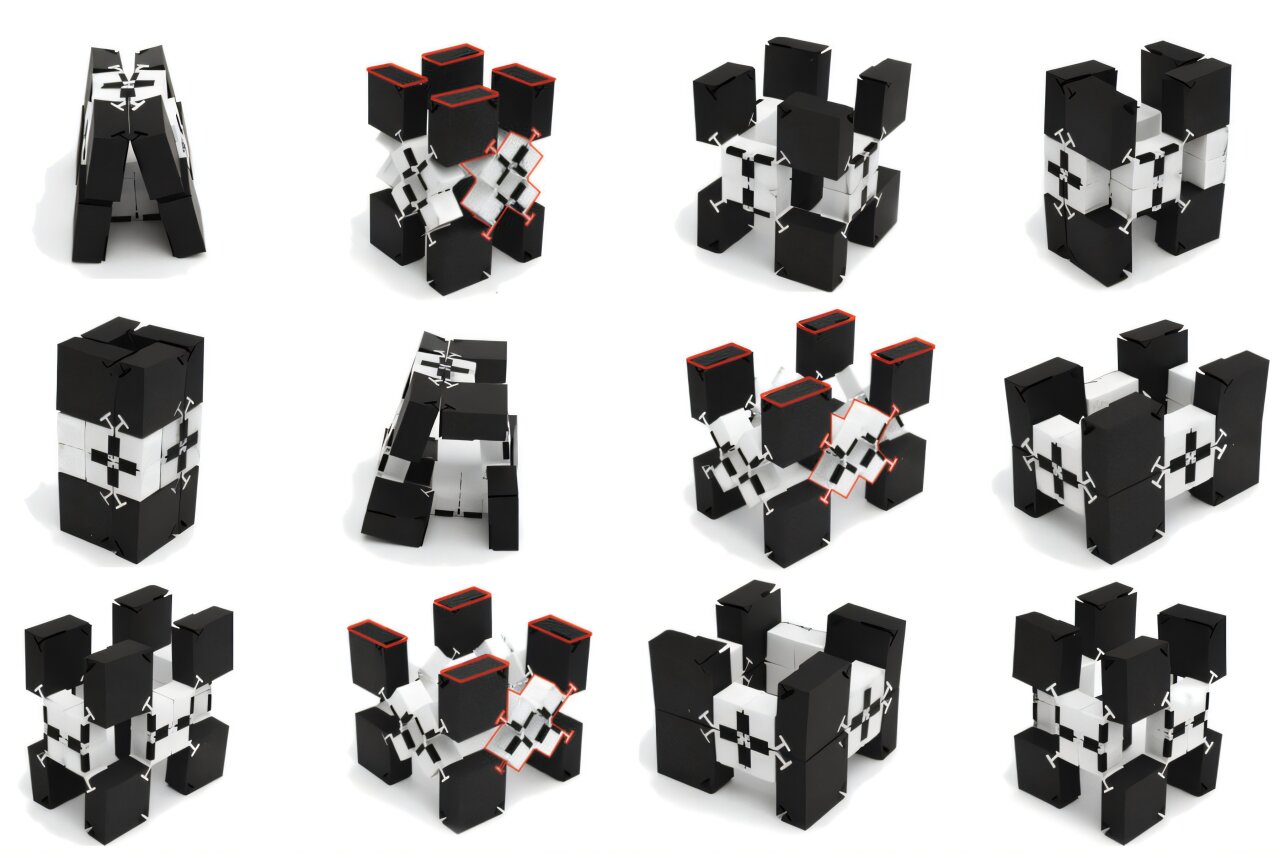
A new set of modular components allows users to create reconfigurable smart devices with electrical connections that keep working no matter what shape the structure forms.
This electrical modularity can enable engineers to design interactive devices that can sense which shape they have taken, without the need for external wires. For instance, the modular components, which the researchers call "bifur-circuits," could be used to rapidly design and prototype adaptable smart devices, like assistive furniture that helps individuals change body positions while recovering from injuries or reconfigurable robotic grippers that remain electrically connected when they change shapes for different applications.
Developed by MIT researchers, these 3D-printed building blocks, which are a type of structure known as a mechanical metamaterial, can be combined to form many more configurations than traditional metamaterial structures.
In a study presenting the new system, the researchers demonstrated several interactive objects, including a chair that converts to a table with storage and can also flatten for stowing. The structure senses its configuration and sends corresponding messages to an electronic display.
These new metamaterials could also be used to design antennas for communications and sensing that form new shapes to adjust their frequencies in changing environmental conditions, without bulky mechanical parts.
"Metamaterials can make complex mechanical assemblies easy to manufacture just by using repeating units. Our work expands on this design space. If we think of mechanical metamaterials as building blocks, then our work is one way to take advantage of their geometry to embed intrinsic intelligence into hardware, which could open many possibilities," says Marwa AlAlawi, a mechanical engineering graduate student and lead author of a paper on the devices.
Source link