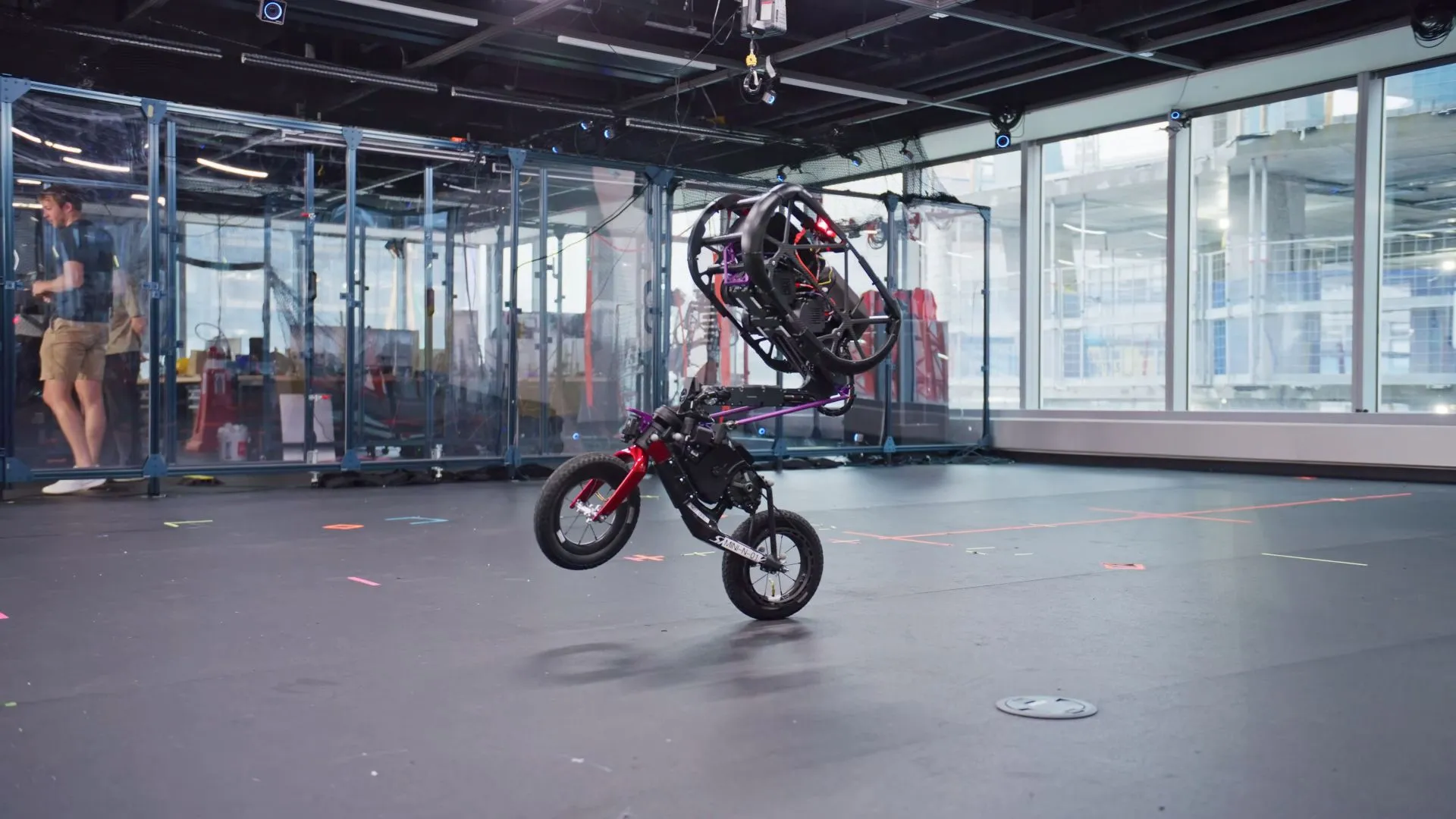
Researchers have developed a bicycle-inspired robot capable of performing acrobatic maneuvers while maintaining balance at high speeds.
The Ultra Mobility Vehicle (UMV) uses a moving reaction mass to control its stability and execute complex movements.
The robot can perform jumps, wheelies, flips, and other maneuvers inspired by mountain biking and trials cycling.
The researchers trained the machine using reinforcement learning, enabling it to navigate obstacles and perform dynamic movements.
Researchers at the Robotics and AI Institute (RAI Institute) have developed the Ultra Mobility Vehicle (UMV), a bicycle-based robot designed to combine fast wheeled movement with the agility of legged machines.
The 51-pound (23.5-kilogram) robot can drive at speeds of up to 8 meters per second (18 mph), balance on its rear wheel, hop sideways, perform wheelies, and execute front flips. Its design uses a movable reaction mass and reinforcement learning to achieve these maneuvers with just five actuated degrees of freedom (DoF), reducing mechanical complexity compared with conventional legged robots.
The UMV consists of three main structural components: a head, a neck, and a bicycle frame. Unlike conventional bicycles, its head houses most of the robot’s mass, including its computing hardware, batteries, and powerful jumping actuators. A spatial linkage connecting the head to the bicycle frame allows the robot to shift its mass and change its orientation during movement.
The linkage consists of the neck and two tie rods, which work together to control the head’s position relative to the bicycle. Two actuators drive the primary movement, while another pair works through the tie rods to enable lateral motion.
Source link