Guides have aided humanity throughout history. Prehistoric civilizations understood that the sun and the moon could be used to navigate vast distances on land and the high seas. Over time, various journeys facilitated the production of maps for better planning and faster travel time to repeat destinations. Centuries later, the introduction of the compass enabled seagoers to achieve greater accuracy in seeking unexplored destinations. And today, GPS navigation apps guide our every journey. In today’s world of agentic AI, AI agents, admittedly, have the potential to enable scalable AI adoption, transforming industries as we know them. However, an intelligent guide, agentic logic, is needed to realize this potential by fueling high agent quality, cost-effectiveness, and consequent end-user trust.
Numerous studies have cited the overwhelming failure of AI pilots, while others have also highlighted the need for AI to operate at the core of enterprise workflows to enable scalable adoption. [1] [2] To better understand this phenomenon and the associated assertion, some analysis of enterprise workflows is required. These workflows are:
A. Dynamic and long-running
B. Possess a plethora of APIs, databases and services
C. Oftentimes are constrained by business policies and/or regulations
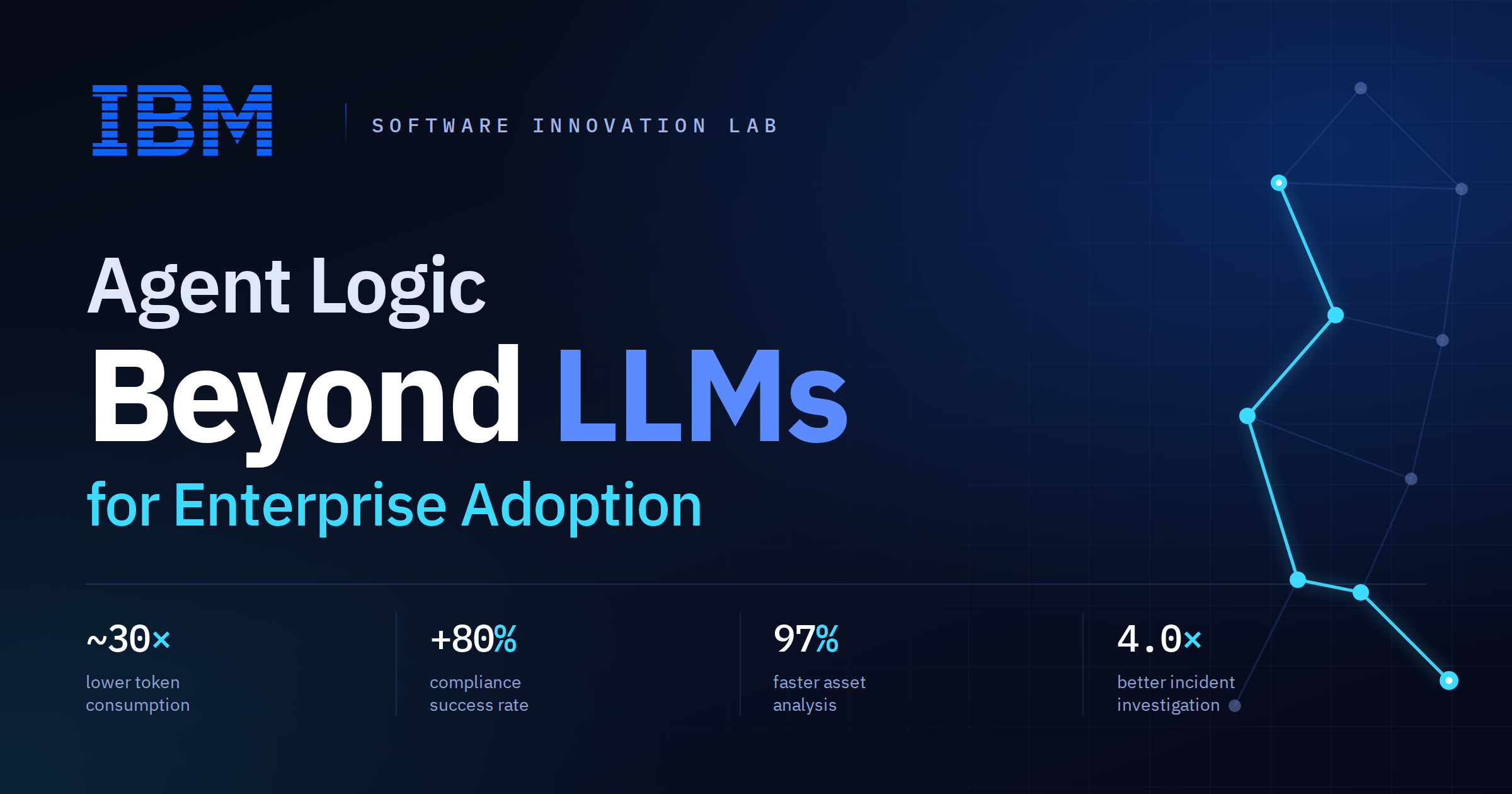
For an agent to function effectively, given these above characteristics, naturally demands an expanded model context, which state-of-the-art frontier LLMs certainly possess, but at what tradeoff? Increased hallucinations, token consumption? Further, can LLMs be equipped with an intelligent guide, GPS, to enable agentic AI execution at the core of the workflow, driving more desirable outcomes? We tested these hypotheses by designing and building agents, equipped with pertinent agent logic, for IBM offerings fully considering the above characteristics.
Source link