AI infrastructure has spent the past several years in a race for compute. More accelerators, larger heterogeneous clusters, and higher peak performance have enabled increasingly capable models. As AI moves into large-scale deployment, infrastructure must support more users, larger models, longer context windows, and more complex applications. Performance still matters, but so do latency, power, utilization, predictability, and cost per inference.
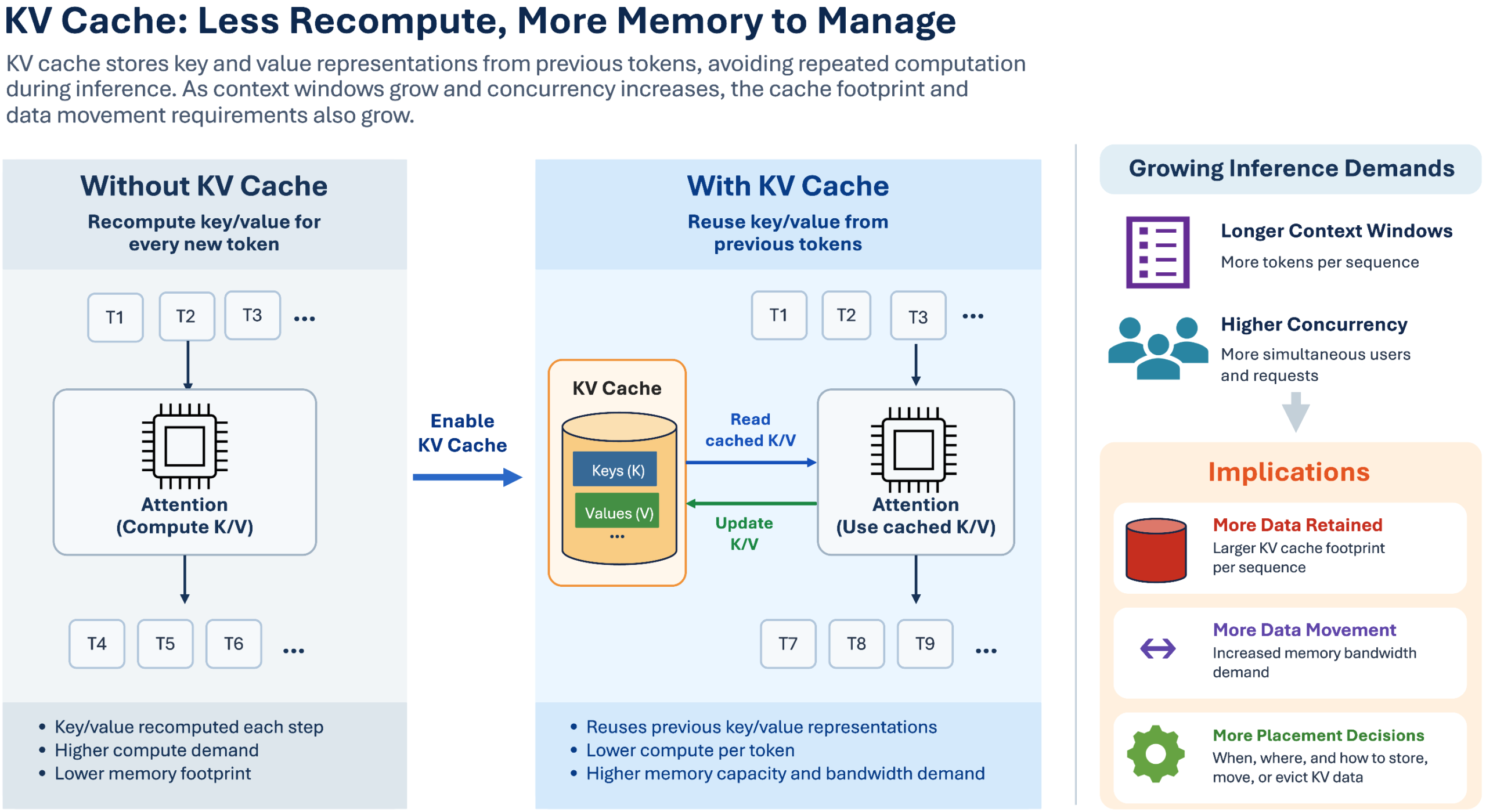
The challenge extends beyond bandwidth. AI systems must balance memory capacity, bandwidth, latency, power, data movement, utilization, and cost. Improving one dimension can create pressure elsewhere. The key-value (KV) cache illustrates this trade-off. KV cache reduces repeated computation during generative AI inference, but requires the system to retain and repeatedly access growing amounts of data. As context lengths and concurrent requests increase, the trade-off becomes more significant.
The result is not simply another memory bottleneck. It is a coordination problem across compute, memory, interconnect, and software. Adding capacity or bandwidth helps only if the system can place, move, and retrieve data without allowing latency, congestion, power, or complexity to erase the benefit.
The memory wall predates AI. Processor performance historically has improved faster than the ability of memory systems to supply processors with data. AI magnifies that problem. Increasing arithmetic throughput delivers limited benefit if accelerators spend more time waiting for data.
But bandwidth is only part of the constraint. AI systems also need sufficient capacity for models, intermediate data, application context, and inference state. Latency affects responsiveness. Power constrains how much data can be moved economically. Packaging and physical connectivity limit how much high-performance memory can be placed near compute.
Source link