
This article has been reviewed according to Science X's editorial process and policies. Editors have highlighted the following attributes while ensuring the content's credibility:
For decades, silicon transistors have driven computational power, and scientists have devoted much of their time to making them smaller. That is because shrinking these tiny electronic switches that make up computer chips allows manufacturers to pack more of them into the same space, increasing computing power.
But as silicon transistors approach just a few nanometers in size, the material that has enabled decades of technological progress is threatened by fundamental physical limits.
Researchers at Carnegie Mellon University have now demonstrated that another class of semiconductors could shrink transistors beyond those limits.
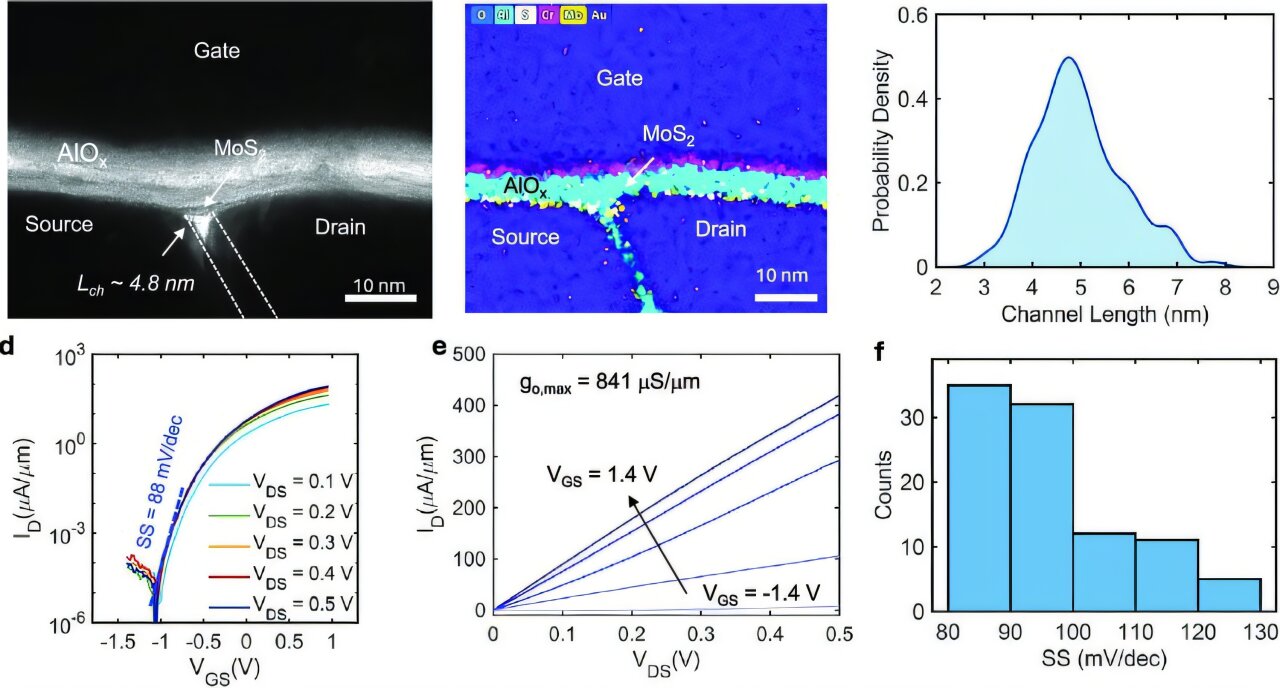
In a study published in Nature Communications, the team built transistors from molybdenum disulfide, MoS₂, an atomically thin, two-dimensional semiconductor. The transistors had physical channel lengths below 5 nanometers and demonstrated switching performance beyond the theoretical limit of silicon at a comparable size.
A transistor works by controlling the flow of electrical current between "on" and "off" states. As silicon transistors become extremely small, the gate that controls the current begins to lose its ability to completely shut the device off. Electrons can therefore leak through the transistor, even when it's supposed to be off. This causes energy waste.
"We need to rethink semiconductor materials, especially in the era of AI computing," said Xu Zhang, associate professor of electrical and computer engineering and corresponding author of the study.
Source link





