An initiative bringing together universities, research organizations, industry, and the open science community to make publicly funded research easier to discover, reuse, and build upon.
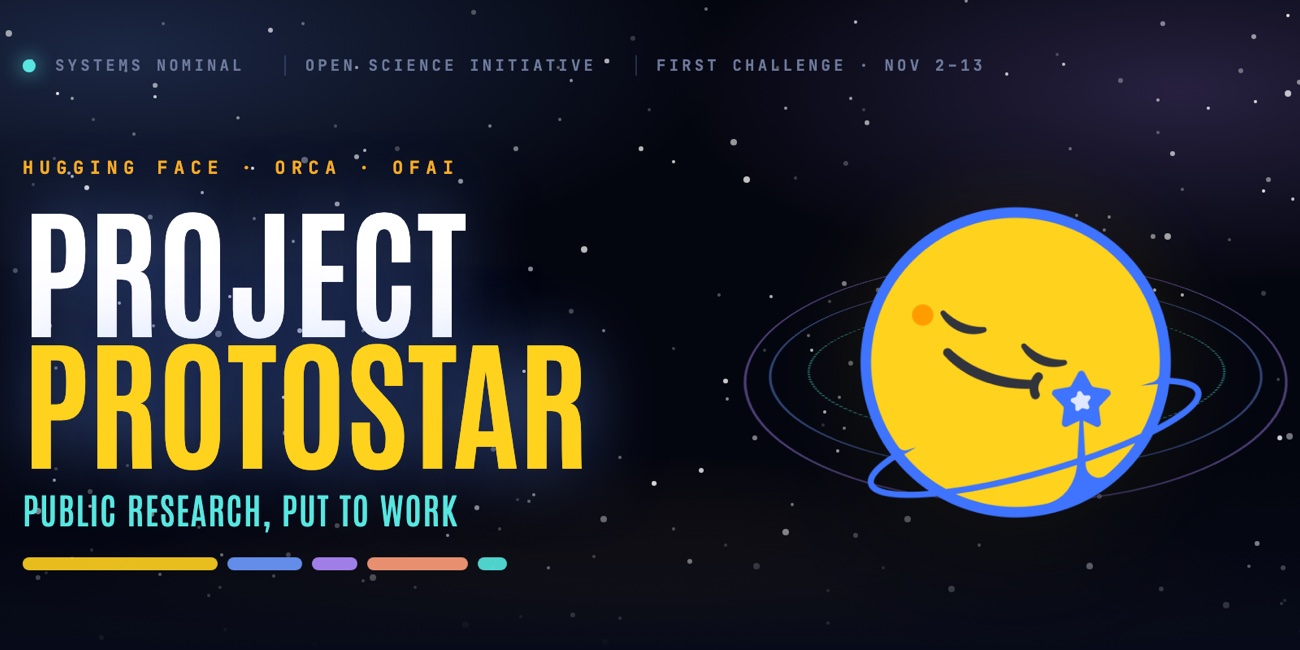
Today, we're announcing Project ProtoStar, an initiative to unlock the potential of publicly funded scientific research by making datasets, models, and code more accessible and reusable, particularly for AI-driven research. ProtoStar brings together research institutions, industry, and the open science community to support the release of scientific artifacts in AI-ready, machine-actionable formats, and to demonstrate their value through a series of open challenges. The first challenge, hosted by Carnegie Mellon University, opens on November 2. See How to Participate below.
The initiative's founding partners include Carnegie Mellon University, Purdue University, Georgia Institute of Technology, Arizona State University, and The George Washington University, all working through the Open Forum for AI (OFAI) as the university coalition partner; the Astera Institute; Hugging Face as the infrastructure partner; and the Open Research Community Accelerator (ORCA), through its Fostering Innovation Network, as the community partner.
Participating organizations formalize their involvement through a memorandum of understanding supporting the release of suitable scientific datasets, models, and code in AI-ready formats on open infrastructure. Organizations interested in joining Project ProtoStar can reach out to protostar@orcaopen.org.
S. federal government invests approximately $190 billion annually in research and development , and federal policy increasingly expects the results to be shared publicly. Agencies such as the National Institutes of Health (NIH) and National Science Foundation (NSF) have strengthened public-access requirements for funded research publications and require researchers to plan for sharing the underlying data.
Source link