Most useful knowledge is written and digitized in English. Most of the people who need it speak, and think, in their own regional languages like Hindi, Tamil, Telugu, Gujarati, Marathi and many others. Many would rather talk than type.
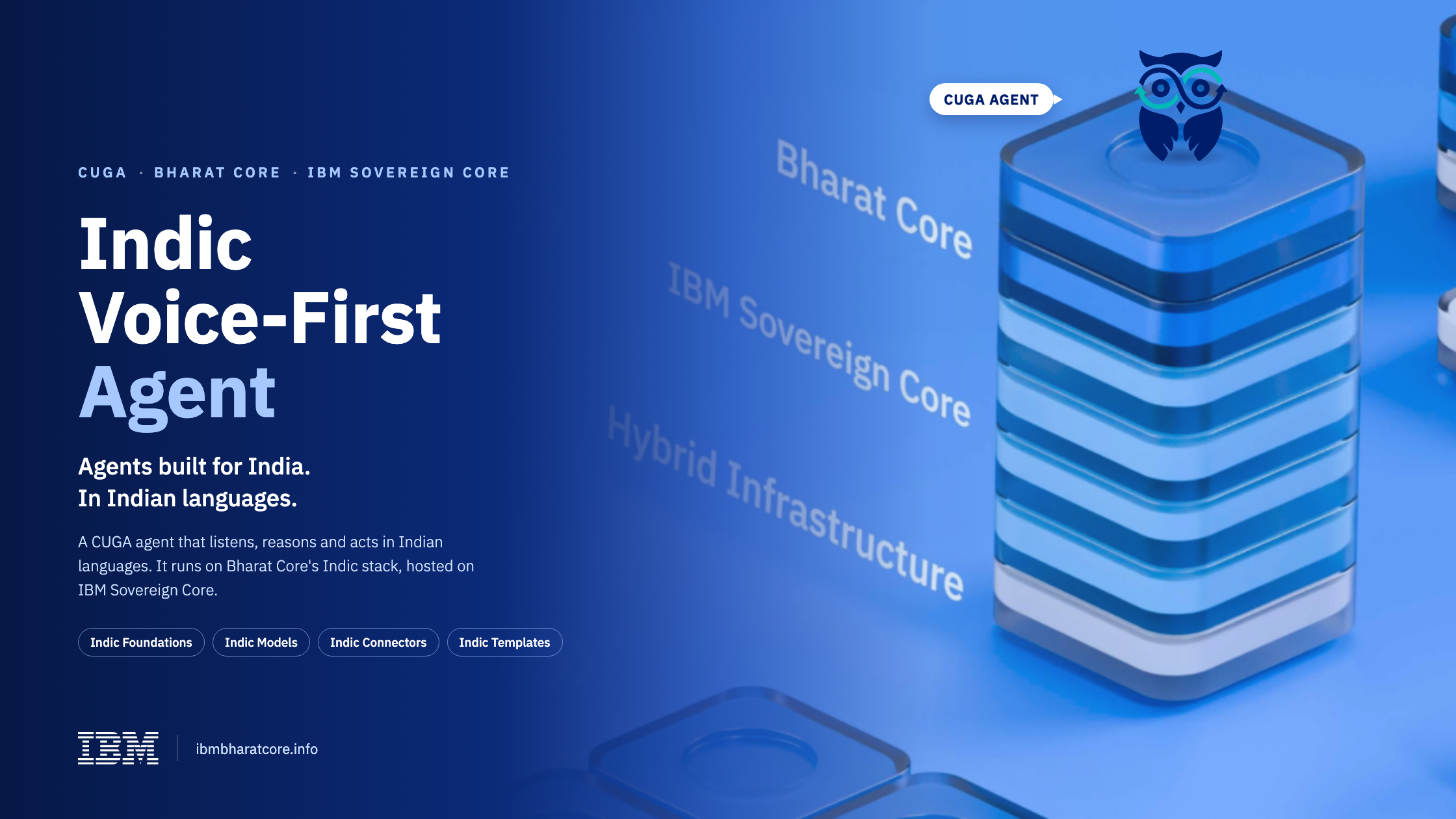
We built a small voice agent to close that gap, using CUGA as the agent harness. This post explains the use case and what we learned. You can try it yourself in CUGA Apps.
A farmer asks a question aloud, in their own language: how do I tell good seed from bad? The agent:
If someone asks about cricket or coding, it politely steers them back to farming instead of making something up.
CUGA (ConfigUrable Generalist Agent) is IBM Research's open-source agent harness. It handles the model wiring, tool management, state and guardrails, so you write tools and a prompt instead of the agent loop. Here we use it as an embedded SDK inside a small web app, for three things:
The key design idea is simple: CUGA is a text-in, text-out brain. Voice is two thin layers around it.
Because the agent only ever sees text, you can build and test it with plain text first, then add the ears and the mouth. You can also swap speech providers without touching the agent. We support two: Sarvam AI's cloud speech APIs, called directly from the user's browser, and open-source models (SraVaani for speech-to-text, Svara for text-to-speech) running on your own server.
Adding speech is the easy part. The hard part is cross-lingual retrieval : a Hindi question has to find an English paragraph.
Source link