
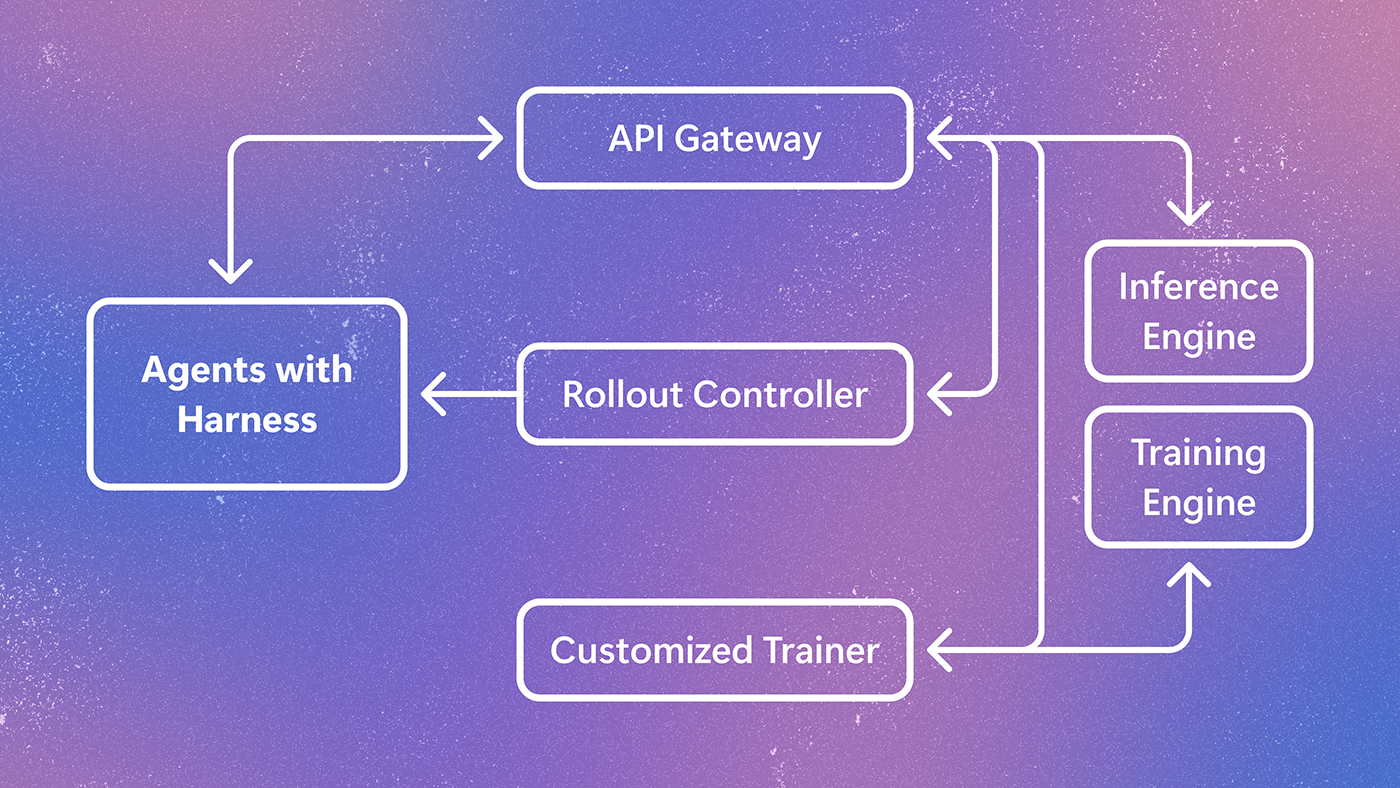
AI agents have evolved from single models to complex full-stack systems built from models, tools, and execution environments. Their capabilities increasingly depend on the agent harness that coordinates them from outside the model. Reinforcement learning (RL) is an approach where AI systems learn through trial and error, guided by rewards and penalties for their actions. RL can make those agents better, but most agent RL systems require developers to reimplement the agent inside the training framework. That is costly, and it means the agent being trained is not quite the agent that gets deployed.
To address this, researchers at Microsoft Research Asia have introduced the Harnessed Agentic RL training paradigm and open-sourced a fully rebuilt Agent Lightning v1.0 (opens in new tab). Compared with the original, Agent Lightning, v1.0 puts more emphasis on staying lightweight, on integrating with real harnesses, and on a complete, reproducible agent RL training pipeline.
Agent Lightning v1.0 was rebuilt around Harnessed Agentic RL, with key improvements:
Traditional agentic RL assumes the training framework owns the interaction loop with the environment. In a ReAct-style loop, the model generates an action, the environment returns an observation, the observation is appended to the context, and the model generates the next action, so the whole rollout maps onto one continuous token trajectory. Early RL systems such as verl, AReaL, and slime were built this way, which meant training an agent required rebuilding its loop inside the RL framework.
Real harnesses have outgrown that assumption. Coding agents such as mini-SWE-agent, OpenHands, OpenCode, Claude Code, and Codex each bring their own context management, tool protocols, execution logic, and dependencies, as do general-purpose agent systems.
Source link





