This article has been reviewed according to Science X's editorial process and policies. Editors have highlighted the following attributes while ensuring the content's credibility:
Research teams led by Professors Jong-Soo Lee of DGIST, Hoon Hahn Yoon of GIST, and Hyun-Soo Ra of Kyungpook National University have developed an ultra-high-precision computational spectrometer based on a single photodetector. The technology is expected to pave the way for commercialization of ultra-compact, low-power spectrometers for integration into smartphones, drones, and autonomous vehicles. Their work is published in Advanced Functional Materials.
A spectrometer is an essential instrument for identifying the composition of materials by analyzing the intensity of light at different wavelengths. However, conventional spectrometers are difficult to miniaturize because they require complex optical components, such as prisms that separate light into different wavelengths, or large numbers of sensors.
To overcome these limitations, computational spectrometers that use artificial intelligence algorithms have emerged. However, existing approaches rely on simplistic voltage control, making it difficult to accurately distinguish wavelength information in mixed light and resulting in substantial noise-induced errors.
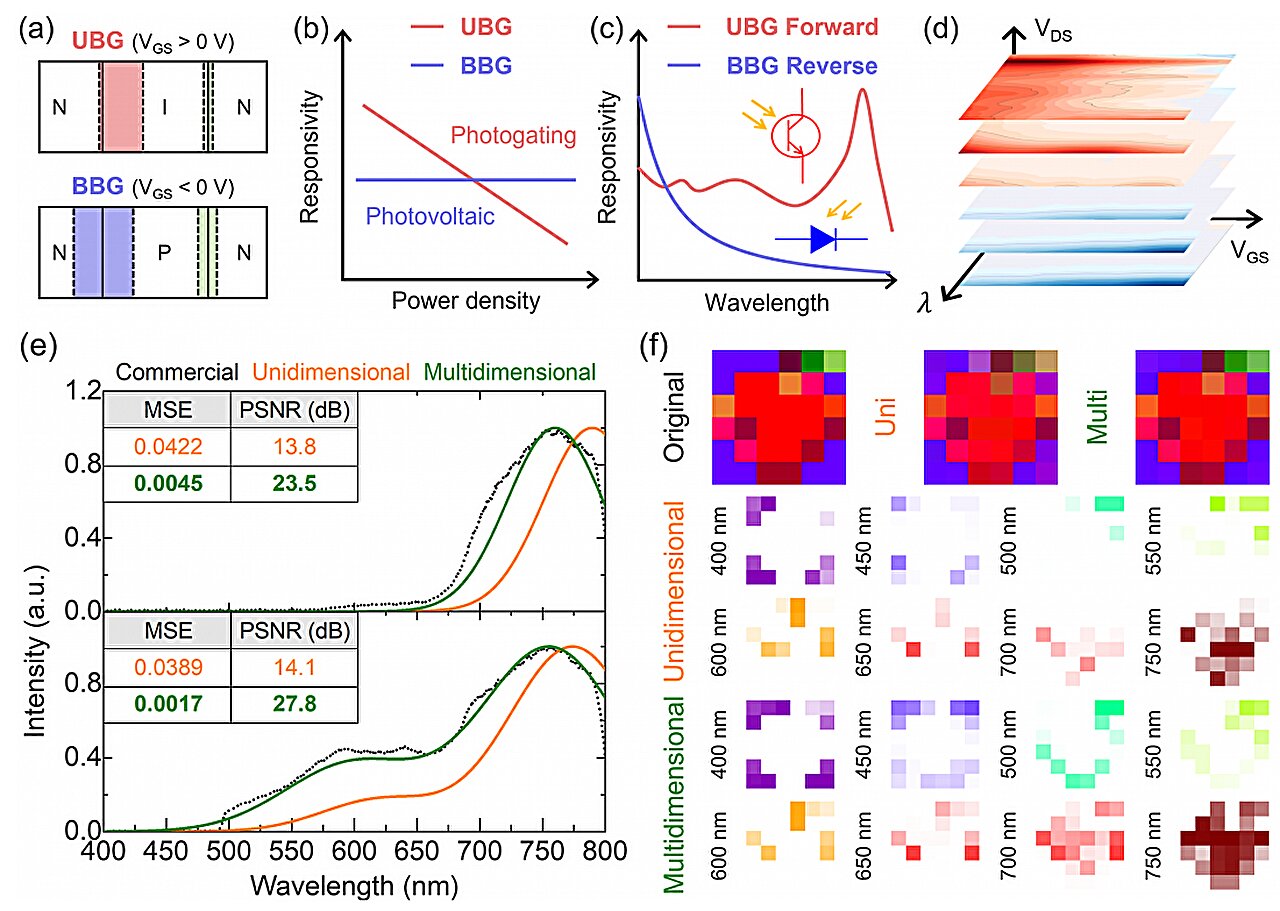
The joint research team addressed this challenge by stacking three semiconductor layers (MoS₂/WSe₂/MoS₂) in a steplike configuration and introducing a specialized structure known as a floating-base bidirectional junction, which enables precise, simultaneous control of two types of voltage.
By combining the two voltages, the researchers could flexibly control the energy barriers at interfaces within the sensor. This allowed them to vary both the magnitude and shape of the sensor's response, even when the incoming light contained multiple wavelengths, thereby enabling the wavelength information of each component to be clearly distinguished.
Source link