This article has been reviewed according to Science X's editorial process and policies. Editors have highlighted the following attributes while ensuring the content's credibility:
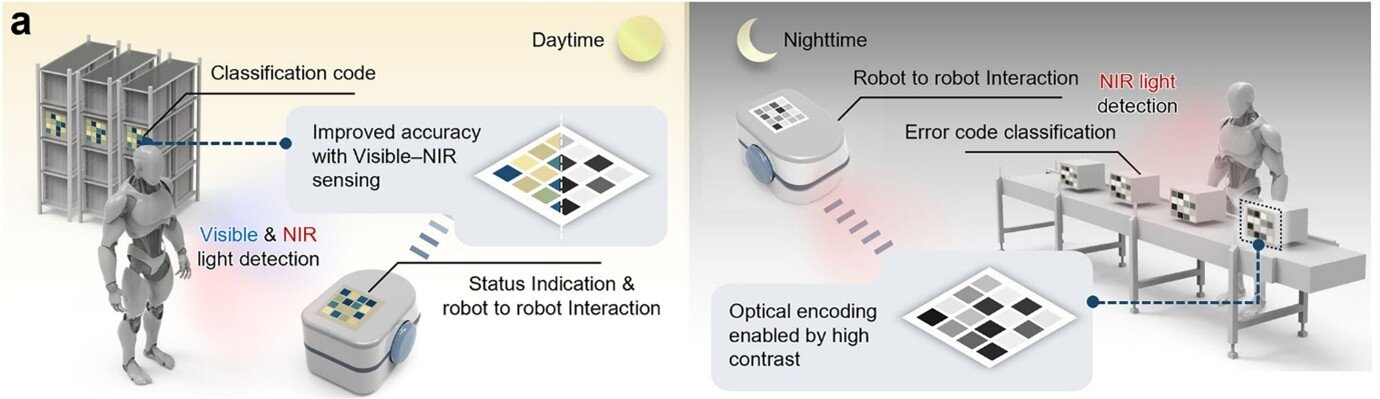
A joint research team from the Korea Advanced Institute of Science and Technology (KAIST) and Yonsei University has developed a flexible display that can communicate information to both humans and robots. Human workers can interpret information through visible color changes, while robots can detect near-infrared patterns invisible to the human eye. The technology could serve as an "electronic tag" attached to products or equipment, allowing humans and robots to monitor work status using the same display.
The research team led by Professor Young Min Song from the KAIST School of Electrical Engineering, in collaboration with Professor Ki Jun Yu from Yonsei University's School of Electrical and Electronic Engineering, developed a flexible reflective display capable of conveying information to both human observers and robotic cameras. The work is published in the journal npj Flexible Electronics.
In factories where humans and robots work side by side, both must be able to identify product types and monitor work status. For example, a label attached to a transport box must help workers determine where to move it while allowing robots to identify the next task. However, information presented solely through colors or text can be difficult to read in dark or hazy environments.
To address this challenge, the research team designed a single display that communicates information differently to humans and robots. While people perceive changes in color, robots use specialized cameras to detect patterns of varying brightness.
Source link