This article has been reviewed according to Science X's editorial process and policies. Editors have highlighted the following attributes while ensuring the content's credibility:
Researchers have developed two new organic semiconductor materials using a light-driven chemical reaction. The paper is published in Chemistry—A European Journal.
The new materials have an internal molecular arrangement that allows them to stack together in crystals so that electrical charge moves efficiently between neighboring molecules. This arrangement could serve as a building block for the next generation of flexible electronics, where alignment of molecules is key.
"The development of lightweight and flexible organic semiconductors, like the ones in this experiment, would be useful in electronics such as bendable displays and wearable sensors," associate professor Yasunori Matsui explained.
An organic semiconductor can achieve optimal performance when "holes," the carriers of electrical charge, can move freely and rapidly from one molecule to another. However, to enable this flow, the molecules must be packed closely and regularly to create the most efficient pathways.
The research group led by specially appointed assistant professor Takuya Ogaki and professor Hiroshi Ikeda at the Graduate School of Engineering at Osaka Metropolitan University synthesized a new sulfur- and nitrogen-containing organic semiconductor using a photochemical reaction.
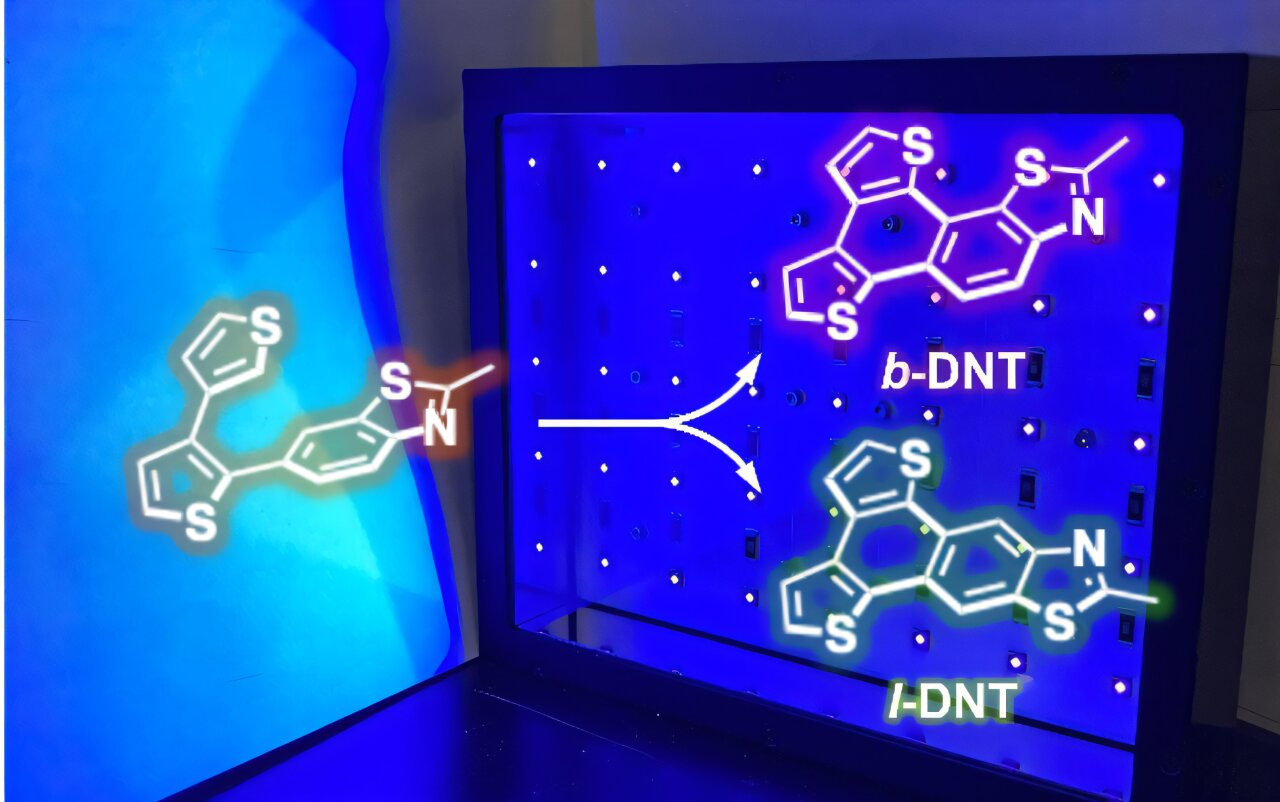
The light triggered a chemical reaction, making parts of the molecule form new carbon-carbon bonds and causing them to fold into a more compact ring structure, ideal for hole transport.
The experiment is the latest in a series of studies on sulfur- and nitrogen-containing semiconductors. In their latest experiment, the researchers found that by changing light irradiation conditions, they could produce a mixture of two distinct molecular structures, a bent isomer (b-DNT) and a linear isomer (l-DNT), or b-DNT exclusively.
Source link